
A pallet of aluminium roofing sheets arrives at a Christchurch construction site with the strap slipped halfway down the load. Nothing snapped. Nothing broke. The strap just didn’t hold its position, and by the time the load reached site, the sheets had shifted enough to need re-stacking before they could be craned off. That’s not a strapping failure in the dramatic sense. It’s a finish mismatch, and it’s more common than most buyers realise.
PET strapping in New Zealand businesses use for palletising and bundling comes in two main surface finishes: smooth and embossed. The choice between them isn’t cosmetic. It affects how the strap grips the load, how it behaves on your strapping tool, and whether it stays put once tensioned. Get the finish wrong for the application and you get slippage, loosening in transit, or a strap that’s harder to seal cleanly. Get it right and the strap does its job quietly, which is exactly what you want from packaging.
What “Finish” Actually Means on PET Strap
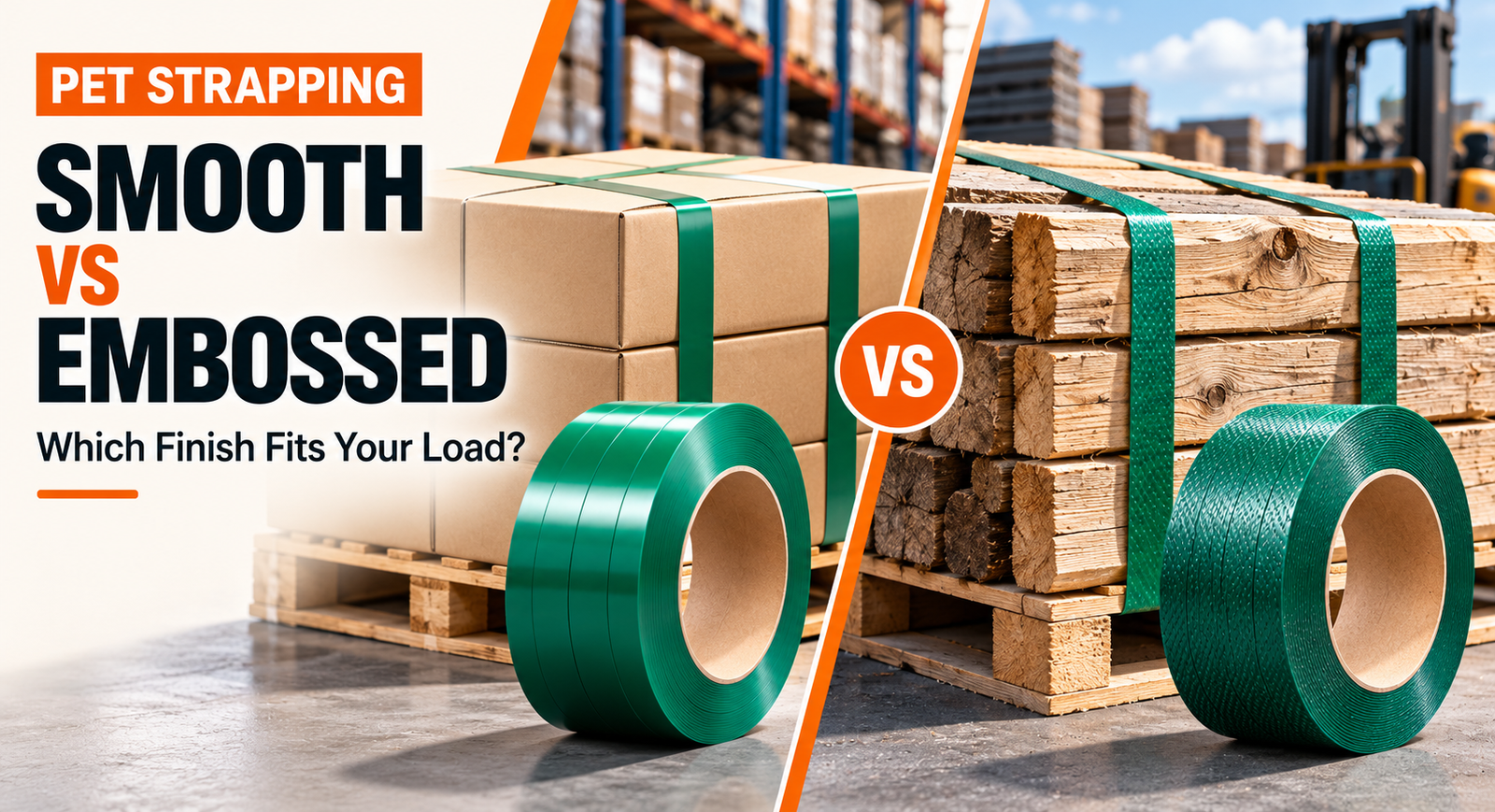
PET strap is made from polyester, valued for its strength-to-weight ratio and its ability to hold tension over time better than PP strapping, which is why it’s the common choice for PET strapping for heavy loads such as steel, timber bundles, and palletised freight. When people are deciding between finishes, they’re usually weighing exactly this decision, not just picking a roll off the shelf. Within PET, the surface can be manufactured smooth or embossed (a textured, slightly raised pattern pressed into the strap during production).
The finish changes two things: friction and flex. A smooth strap has a flatter, glossier surface. An embossed strap has more surface texture, which changes how it sits against the load and against the sealing mechanism on your strapping tool.
Neither finish is “better” in isolation. The right one depends on the load shape, the surface it’s wrapping, and the tool doing the tensioning.
Smooth PET Strapping: Where It Earns Its Place
Smooth PET strapping has a clean, low-friction surface. That’s an advantage in specific conditions:
- Runs more freely through automatic and semi-automatic strapping machines, which tend to favour a consistent, uninterrupted surface feed
- Sits cleaner against smooth, hard-edged loads such as steel plate, tile pallets, and stacked cartons, without catching or bunching
- Gives a tidier finished appearance, which matters for retail-facing or export-presentation loads where the strap is visible, which is where premium smooth PET strapping tends to earn its keep over a standard grade
For general-purpose runs, standard grade smooth PET strap covers most flat, rigid loads without needing to step up a tier. Businesses working toward a lower-impact packaging line often look at eco PET strapping in a smooth finish for the same application.
The trade-off is grip. On rounded, uneven, or shifting loads, a smooth strap can be more prone to slipping under vibration, particularly on longer transport runs. It’s the right call when the load itself is stable and the packaging line is doing the heavy lifting on speed and consistency.
Embossed PET Strapping: Where It Earns Its Place
Embossed PET strapping trades some of that low-friction glide for grip. The raised texture bites slightly into the load surface and against itself at the seal point, which is why it’s the more common recommendation for:
- Timber bundles and sawmill output, where the strap needs to hold across an uneven, rounded surface
- Bundled steel bars and rods, where individual pieces can shift against each other if the strap loses tension
- Scrap metal and baled export loads (cans, cardboard, tyre bales), where load density is inconsistent and the strap is under real stress from irregular pressure points
- Manual strapping tools, where the added grip helps the strap hold its tension while the operator seals it, rather than relying purely on machine-consistent tension
New Zealand’s wool and tyre bale export sectors still lean heavily on steel strap for exactly this reason: grip and holding power on irregular bales. Premium embossed PET strapping is worth a genuine look here, offering steel-comparable holding characteristics on that kind of load without steel’s weight, sharp edges, or the handling risk that comes with a snapped steel strap under tension. For lighter bundling and general warehouse use, standard embossed PET strap or the eco embossed PET strapping option both cover the different grip requirement at a different price point.
Smooth vs Embossed: The Direct Comparison
Strength ratings between the two finishes are often similar at the same width and grade. What actually determines PET strapping strength and stability in practice is how that strength gets applied to the load, not the number on the spec sheet.
| Factor | Smooth PET Strapping | Embossed PET Strapping |
| Surface grip | Lower friction, glides through tooling | Higher friction, holds position on uneven loads |
| Best suited to | Flat, rigid, stable loads | Irregular, rounded, or shifting loads |
| Machine compatibility | Favoured in automatic and semi-automatic lines | Common with manual and hand-grade tooling |
| Typical application | Steel plate, cartons, tile, retail-facing loads | Timber, bundled steel bars, scrap export, bales |
| Visual finish | Cleaner, glossier | More textured, less refined-looking |
The Mistake Businesses Actually Make
The most common error isn’t choosing the wrong finish outright. It’s choosing whichever finish the business has always bought, without matching it to the specific load going out that week. A warehouse running mixed loads (say, cartons on Monday and bundled timber offcuts on Thursday) using one strapping stock for both will get inconsistent results on one or the other, and usually blames the strap rather than the mismatch.
The fix is simple in principle and rarely done: match the finish to the load, not to habit. If your operation regularly handles both flat, rigid product and irregular or bundled product, it’s worth stocking both smooth and embossed rather than defaulting to a single roll type across everything you pack.
Buying Considerations Before You Order
A few practical checks before locking in a finish:
- What does the strap sit against? Flat and hard favours smooth; round, bundled, or textured favours embossed
- What tool is running it? Confirm your strapping tool (manual, battery, or pneumatic) is rated for the strap width and finish you’re ordering, since machine wear and seal quality differ between the two
- Is this a steel-replacement decision? If you’re currently using steel strap on bales or bundles for holding power, embossed PET is the finish worth trialling first
- Is the load export-bound? Check whether the destination or freight handler has any finish or colour preference, particularly for green strapping roll stock used in some export contexts
None of these are complicated questions, but they’re the ones that actually get skipped when strapping is bought on autopilot.
If your operation is running the same PET strapping finish across every load type regardless of what’s going out the door, it’s worth a five-minute conversation with CustomPack, one of the more established PET strapping suppliers New Zealand businesses already work with, before your next order rather than after the next load shifts in transit.
FAQs
What is the difference between smooth and embossed PET strapping?
Smooth PET strapping has a low-friction surface suited to flat, rigid loads. Embossed PET strapping has a textured surface that grips better on uneven or bundled loads.
Which PET strapping finish is best for palletising?
For flat, stable pallets like cartons or steel plate, smooth PET strapping works well. For irregular or bundled pallet loads, embossed PET strapping holds tension more reliably.
Is embossed PET strapping stronger than smooth PET strapping?
Not in raw breaking strength. Both can share the same tensile rating at equal width and grade. The real difference is surface grip, not strength.
Can smooth PET strapping be used on timber bundles?
It can, but embossed PET strapping is generally recommended for timber, since its textured surface holds better across the uneven, rounded surface of a timber bundle.
Does the strapping machine affect which finish I should choose?
Yes. Automatic and semi-automatic machines usually run smooth PET strapping more consistently. Manual strapping tools often perform better with embossed PET strapping.
Why do some New Zealand exporters still use steel strapping instead of PET?
Steel is traditionally used on wool and tyre bales for grip on irregular loads. Embossed PET strapping now offers comparable holding power without steel’s weight or edge risk.
What PET strapping finish suits construction materials like steel roofing?
Flat steel roofing sheets generally suit smooth PET strapping for a clean, consistent hold. Bundled or uneven framing timber holds better under embossed PET strapping.
Does PET strapping finish affect how a pallet looks for export?
Yes. Smooth PET strapping gives a cleaner, glossier finish suited to export or retail-facing pallets. Embossed PET strapping has a more visibly textured appearance.
Can one business use both smooth and embossed PET strapping?
Yes, and many should. Businesses handling mixed load types, such as cartons and bundled timber, benefit from stocking both finishes rather than one for everything.
Who supplies PET strapping in New Zealand?
CustomPack is one of the PET strapping suppliers in New Zealand businesses turn to for both finishes, across eco, standard, and premium grades, matched to your load type and strapping tool.