
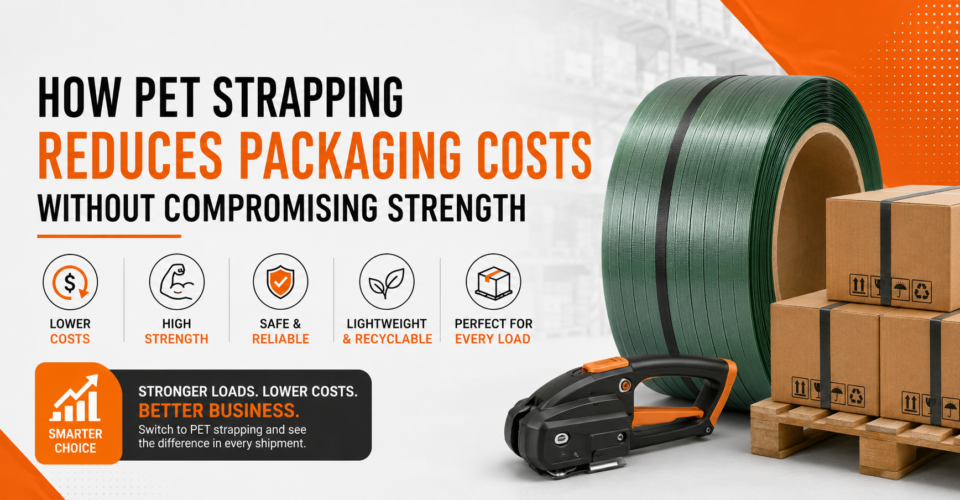
Every warehouse manager in New Zealand has faced the same dilemma at some point: cut packaging spend or protect the load. For years, that meant choosing between cheap strapping that snapped mid-transit or expensive steel strapping that ate into margins. PET straps have closed that gap, and most businesses that switch don’t go back.
If you’re sourcing packaging supplies NZ-wide and still running steel or low-grade plastic straps, this is worth understanding.
What Makes PET Strapping Different From Traditional Packaging Materials
PET strap is made from polyester resin, the same base material used in plastic bottles, which is recycled and re-engineered into a high-tensile-strength strapping material. Unlike ordinary plastic straps, PET strapping is manufactured to hold elongation and recovery properties similar to steel but at a fraction of the weight and cost.
Packaging strapping isn’t just about securing a box; it’s about keeping entire loads stable during transport, storage, and handling. A pallet that shifts in transit doesn’t just risk damage; it risks the entire shipment being rejected at the receiving end.
The Real Cost Comparison: PET Strap vs Steel vs Ordinary Plastic
Steel strapping has one advantage: raw tensile strength. But it comes with a long list of hidden costs: rusting in humid NZ warehouses, sharp edges causing injury claims, higher freight weight, and tooling that requires trained handling.
An ordinary plastic strap is the opposite problem. It’s cheap upfront, but it snaps under tension, meaning more rejected pallets, more product damage, and more straps consumed per shipment to compensate for failures.
PET strapping delivers a stronger balance of cost, safety, and performance for many real-world applications:
- No rust, no corrosion; works fine in coastal Auckland humidity.
- Higher break strength than PP straps, closer to steel-level tension retention.
- Lighter than steel, which reduces freight cost per pallet.
- Doesn’t require the specialised tensioning tools used for steel strapping.
- Safer to handle – no sharp burrs.
For businesses shipping heavy or export-bound pallets, this combination directly reduces total cost per shipment, not just cost per roll.
Where the Actual Savings Come From
This is the part most suppliers don’t explain clearly. The savings aren’t just in the price per metre of strap. They show up in four places:
- Fewer failed loads: When a strap breaks in transit, someone has to rewrap and reship. That’s labour, time, and sometimes a damaged product write-off. PET strapping’s tension retention means fewer snapped straps mid-transport.
- Lower freight weight: PET strap weighs significantly less than steel per equivalent tensile strength. On high-volume freight routes, that adds up across hundreds of pallets a month.
- Reduced strap consumption: Because PET strap holds tension over time instead of loosening like ordinary plastic strap can, fewer straps are needed per pallet to achieve the same load-securing result.
- Lower injury and handling risk: No burrs, no rust flakes, and no steel-edge cuts, which means fewer safety incidents and fewer disrupted shifts on the floor.
None of this shows up on the invoice for the strap itself. It shows up in the freight bill, the labour report, and the damage claims log a quarter later.
Strength Without the Trade-Off
The idea that “cheaper packaging materials NZ businesses use must be weaker” doesn’t hold up with PET straps specifically. It’s engineered for high load-securing performance: heavy pallets, machinery parts, timber bundles, and export containers without needing the bulk or weight of steel.
For businesses that currently reach for heavy-duty packaging tape as a load-securing solution on heavier items, it’s worth noting tape was never designed for that job. Tape holds boxes closed. It doesn’t hold a pallet together under transport vibration. PET strapping is purpose-built for exactly that stress.
If you want an embossed finish for extra grip during manual tensioning or a smoother finish for machine-fed operations, both are available, which is where eco pet strapping (smooth) comes in for operations running automated or semi-automated strapping lines that need consistent feed without surface drag.
Who Actually Benefits Most From Switching
- Export shippers needing consistent load securing across long transit times and multiple handling points
- Warehouses and 3PLs moving high pallet volumes daily, where even small per-unit savings compound fast
- Manufacturers bundling heavy or irregular-shaped goods like timber, pipes, or metal stock
- Retail and FMCG distributors who need dependable pallet strapping without steel’s safety overhead
If your operation fits any of these, the switch to PET strap tends to can begin delivering measurable savings within the first few shipments.
A Quick Reality Check Before You Switch
PET strapping isn’t the right call for every application. Extremely sharp-edged loads or applications requiring maximum static holding force over long-term storage (rather than transport) may still favour steel.The honest answer: for the vast majority of standard pallet, carton, and bundle applications, standard PET strapping performs at or above expectation — the exceptions are the edge cases, not the norm.
Frequently Asked Questions
- How does PET strapping reduce packaging costs?
It reduces costs through fewer failed loads, lighter freight weight compared to steel, less strap consumption due to better tension retention, and reduced injury-related downtime, savings that show up across freight, labour, and claims, not just the strap’s purchase price. - Is PET strapping strong enough for heavy loads?
Yes. PET strap is engineered to retain tension under load, making it suitable for heavy pallets, machinery, timber bundles, and export shipments where ordinary plastic strap would fail. - Can PET strapping replace steel strapping?
In most standard freight and pallet-securing applications, yes. Steel still holds an edge in extreme static-load or long-term storage scenarios, but for transport and general load securing, PET strapping matches or exceeds steel’s practical performance without the rust, weight, or handling risk. - What industries commonly use PET strapping?
Export and freight logistics, warehousing and 3PL operations, timber and metal manufacturing, and FMCG or retail distribution all rely heavily on PET strap for pallet and bundle securing. - Is PET strapping recyclable?
Yes. PET strap is made from a recyclable polyester base and can often be recycled through PET recycling streams where suitable recycling facilities exist. - What is the difference between smooth and embossed PET strapping?
Embossed PET strap has a textured surface that improves grip during manual tensioning, while smooth PET strapping is designed for machine-fed, automated strapping lines where a consistent, low-drag surface improves feed reliability. - Is PET strapping suitable for export shipping?
Yes. Its tension retention, corrosion resistance, and lighter weight compared to steel make it well suited to the extended handling and transit conditions typical of export shipments.