
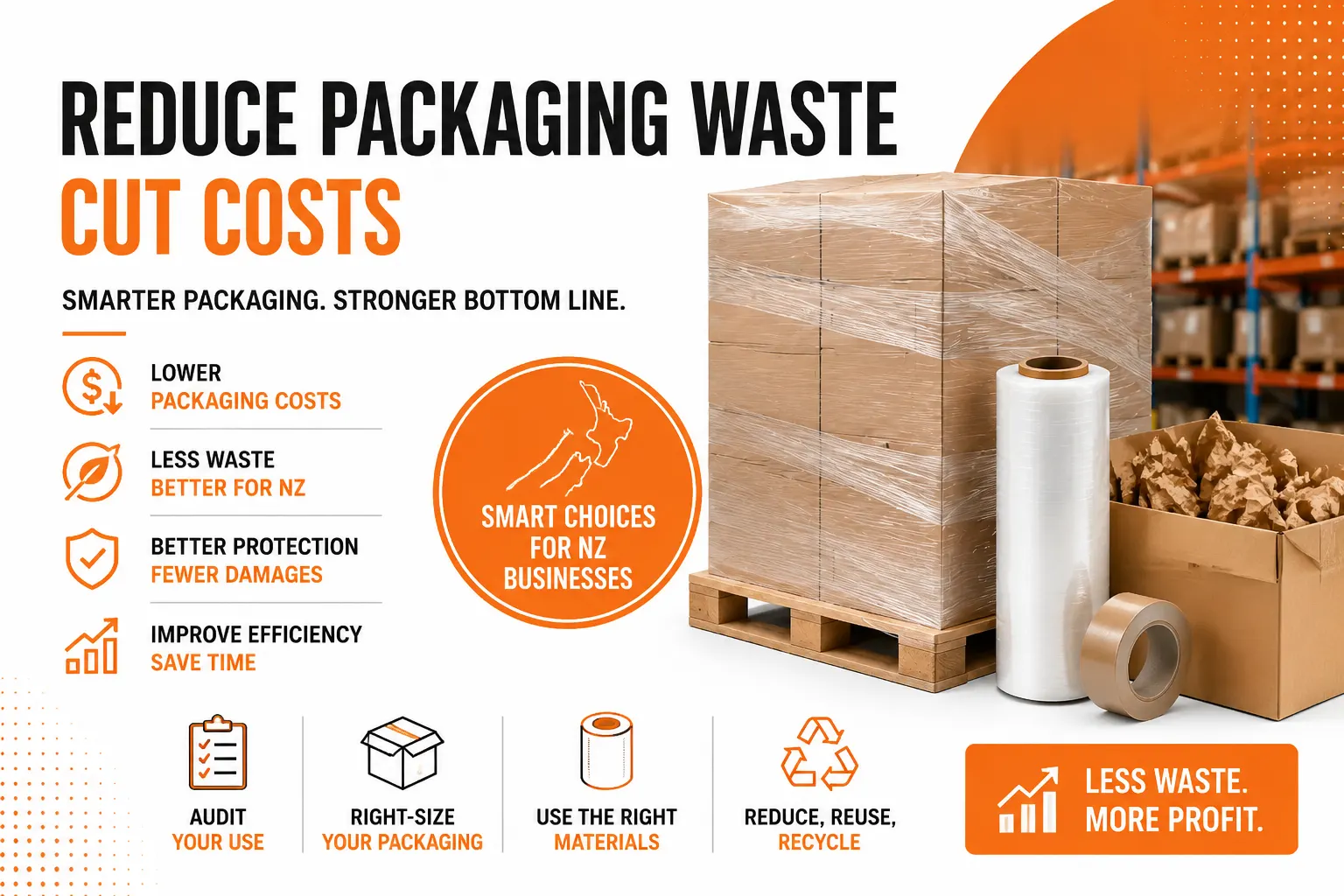
Every warehouse in New Zealand is sitting on a hidden cost center. It is not labor. It is not freight. It is the packaging that gets peeled off, chucked in the bin, or used in the wrong amount every single day without anyone noticing.
The problem is not that Kiwi businesses do not care. The problem is that packaging waste rarely shows up as its own line item. It hides inside consumables, gets buried in general operational spend, and nobody questions it until margins get squeezed.
This guide is about fixing that. Not with vague sustainability goals or green marketing talk, but with practical changes that NZ warehouses can make right now to reduce packaging waste and cut costs at the same time.
Why Packaging Waste Is Costing You More Than You Realize
Before you can cut costs, you need to understand where the money actually goes.
For most Kiwi businesses, packaging waste falls into three key areas:
- Material overuse: Applying more stretch film, tape, or strapping than a load actually needs.
- Product damage: Under-packaging can lead to returns, replacements, and unhappy customers.
- Disposal costs: Excess cardboard, film, and strapping take up space and require time and resources to remove.
A warehouse packing 50 pallets a day with an inefficient stretch film technique could easily be burning through 30 to 40 percent more film than needed. At current NZ stretch film prices, that adds up across a year faster than most ops managers expect.
The good news is that the same changes that reduce waste also reduce cost. These are not competing goals.
Start With a Packaging Audit
The single most effective first step is one that almost nobody takes: a proper packaging audit.
Walk your warehouse floor and ask three questions for every material you use. How much are you actually applying versus how much is needed? What is your damage rate on outbound goods? And how much packaging material is going in the skip or the recycling bin at the end of each shift?
You do not need expensive software for this. A simple count of how many rolls of stretch film, boxes, tape, and strapping consumables you use per week versus the volume of goods shipped gives you a baseline. That baseline is where your savings start.
Most NZ operations that do this exercise for the first time find at least one or two immediate wins they did not know were sitting right there.
Right-Sizing Your Boxes and Cartons
One of the biggest sources of packaging waste in ecommerce and distribution warehouses is the wrong box for the product.
When a product that fits in a 200mm x 150mm carton gets packed into a 400mm x 300mm box because that was what was available, you are paying for extra cardboard, wasting space in the courier or freight vehicle, and stuffing in unnecessary void fill to compensate. All of that costs money that should be sitting in your margin.
Right-sizing means stocking a range of carton dimensions that actually match your product mix, rather than defaulting to a few standard sizes that sort of work for everything. It is not about having hundreds of box SKUs. It is about eliminating the two or three sizes that cause the most waste and replacing them with dimensions that actually fit your products.
NZ businesses that right-size their carton range typically find they reduce cardboard consumption by 15 to 25 percent. The freight savings from better cube utilization often exceed the packaging savings themselves.
Sort Out Your Stretch Film Application First
If you wrap pallets, stretch film is almost certainly your highest-volume packaging consumable. It is also where waste is easiest to create and hardest to spot.
The most common mistake in NZ warehouses is applying hand wrap at low or zero pre-stretch. Stretch film is designed to be stretched before it goes on the pallet. A quality 23 micron hand wrap with proper technique can stretch to 200 to 250 percent of its original length, meaning one meter of film covers two to two and a half meters of pallet surface. When operators apply it flat or barely stretched, you burn through rolls two to three times faster than necessary.
The second mistake is over-wrapping. Most stable loads only need four to six wraps of film with proper tension. Walking around a pallet eight to ten times with loose film does not make it more secure. It just makes the roll run out faster.
If you are wrapping more than 15 to 20 pallets a day, switching to machine grade stretch film is worth calculating. The cost per pallet drops significantly at machine application rates and you get far more consistent results.
If you want to work out exactly how much film you should be using per pallet, a stretch film calculator is a useful starting point.
Void Fill: Where NZ Businesses Tend to Overspend
Void fill is the packaging material used to stop products shifting around inside a shipping box in transit. It is also one of the easiest places to overspend without realizing it.
Bubble wrap, foam peanuts, and crumpled paper all do the same basic job but vary widely in cost, sustainability, and how your customers feel when they open the box. The right choice depends on your product type, damage rates, and how your goods are shipped.
For most NZ ecommerce and B2B shipments, paper void fill or air pillows offer a better balance of cost and protection than foam peanuts. Paper is recyclable, which matters more and more to Kiwi customers. Air pillows use minimal material and take up less storage space before use.
The real fix, though, is pairing better void fill with right-sized boxes. When the box fits the product properly, you need a fraction of the void fill you are currently using.
Strapping: Pick the Right Material and Stop Over-Applying
Strapping waste in NZ warehouses usually comes down to two things: using the wrong type of strapping for the load, or using more strapping than the load actually needs.
Polypropylene (PP) strapping is the lightest and most cost-effective option and suits most light to medium loads just fine. For heavy or sharp-edged loads, PET (polyester) strapping offers better retained tension and higher break strength without the weight or cost of steel.
The mistake a lot of NZ businesses make is defaulting to steel strapping on loads that PP or PET would handle just as well. Steel costs more per meter, weighs more, and creates a hassle for whoever has to get rid of it on the receiving end. Switching to PET strapping where steel was previously the default often cuts material cost by 30 to 50 percent on those applications while actually improving load security.
On the flip side, using heavier strapping than a load requires is pure waste. A 200kg pallet of light goods does not need the same strapping spec as a 1,200kg load of timber.
Sustainable Packaging in NZ: What the Market Actually Expects Now
The sustainability conversation in New Zealand has moved well past optional. Retailers, export partners, and end customers are increasingly asking about packaging choices, and the regulatory direction around single-use materials is only heading one way.
The practical reality for NZ warehouses is that sustainable packaging and cost-efficient packaging are increasingly the same thing. Lighter materials use less raw product. Recyclable options reduce disposal costs. Packaging that is sized correctly wastes less at every point in the chain.
If you export, the packaging requirements of your destination market may set the standard you have to meet anyway. Australian and European buyers often specify material types, and sorting that out from the start avoids expensive re-packing further down the line.
Choosing a NZ packaging supplier that carries both conventional and sustainable options means you are not forced into a false choice between doing the right thing and keeping costs under control.
Set Packaging Standards Across Your Team
Even the best packaging materials create waste when they are applied inconsistently.
The most cost-efficient warehouses in New Zealand are the ones where everyone who touches packaging knows the standard: how many wraps of stretch film per pallet, which box size goes with which product range, how much tape is needed per carton. That sounds straightforward, but in practice most warehouses have three or four different ways people do the same task, and the most wasteful version drags up the average.
Simple visual guides at each packing station work better than written SOPs that get filed away and never read. A photo showing the right number of stretch wraps, or a laminated card showing which box size matches which product, cuts variation without adding complexity to the job.
Getting new team members trained on packaging application from day one, not just on the products themselves, saves money right away.
Track Your Consumption and Set a Target
You cannot reduce what you do not measure.
Start by monitoring:
- Monthly spend on packaging materials such as stretch film, tape, cartons, and strapping.
- Number of pallets or units shipped during the same period.
- Cost per pallet or cost per unit shipped to establish a clear benchmark.
- Usage trends over time to identify waste, training issues, or process changes.
Track these figures monthly and compare them against your targets. Even a small reduction in packaging consumption can create meaningful savings over time.
Work With Your Packaging Supplier, Not Around Them
A lot of NZ businesses treat their packaging supplier as someone they call when stock runs low. The ones who get the most value treat them as a technical resource.
A good packaging supplier can tell you whether the stretch film gauge you are using actually suits your load type, whether there is a more cost-effective strapping option for your application, and whether the box dimensions you are buying are available in a size that fits your products better.
At Custompack, this is the kind of support businesses rely on every day. Rather than simply supplying packaging products, the team works with customers to help identify practical ways to reduce waste, improve load security, and get better value from their packaging spend.
That kind of advice is genuinely useful and most suppliers will offer it if you ask. The conversation about reducing your packaging spend is not one a good supplier will shy away from. They would rather help you get it right and keep you as a long-term customer than watch you burn through the wrong materials and look elsewhere.
The Real Cost of Carrying On as You Are
Every week a warehouse ships with inefficient packaging is a week of margin left on the floor. Materials cost more than they should. Labor time spent applying excess wrapping adds up. Damage from under-protection creates costs downstream that never get traced back to packaging. And disposing of wasted material takes up space and time that could be used better.
None of these feel large on their own. Together, across a full year of operations, they are often significant enough to fund a meaningful investment somewhere else in the business.
The NZ businesses that compete best on cost are rarely the ones that found a cheaper supplier. They are the ones that got disciplined about how they use what they already buy.
Having a look at your packaging spec, even just for stretch film and box sizing, is a solid starting point. If you want help working out the right materials for your specific loads and volumes, talk to a packaging supplier that knows the NZ market and will give you a straight answer rather than just sell you what they have in stock.
Frequently Asked Questions
1. What is the fastest way to reduce packaging costs in a NZ warehouse?
The fastest win is almost always stretch film application. Checking that your team is pre-stretching film correctly and not over-wrapping pallets can cut stretch film consumption by 25 to 40 percent without changing any materials at all. It costs nothing to fix and the savings show up straight away.
2. Is sustainable packaging more expensive in New Zealand?
Not necessarily. Lighter materials and right-sized packaging often cost less per unit than heavier conventional alternatives. Recyclable paper void fill, for example, is frequently cheaper per cubic meter than foam peanuts. The upfront cost of sustainable options has come down significantly as Kiwi demand has grown.
3. How do I know if I am using the right stretch film for my pallets?
The right stretch film depends on your load weight, pallet height, and whether you are wrapping by hand or machine. As a general guide, hand wrap film between 17 and 23 micron suits most standard pallets. Heavier or irregular loads may need a higher gauge or a specialized extended core film. A stretch film supplier in NZ should be able to recommend the right spec based on your load type.
4. What is right-sizing packaging and how does it reduce waste?
Right-sizing means choosing box or carton dimensions that match your product as closely as possible, rather than defaulting to a standard size that is larger than needed. Smaller boxes use less material, need less void fill, and ship more efficiently. Businesses that right-size their carton range typically see material savings of 15 to 25 percent plus freight savings from better space utilization.
5. How many wraps of stretch film does a pallet actually need?
For most standard warehouse pallets, four to six wraps with proper tension and pre-stretch is enough. The exact number depends on load weight, stability, and how far the goods are traveling. Over-wrapping beyond what the load needs does not add meaningful security and just burns through film. If loads are shifting in transit, the issue is almost always tension or technique rather than the number of wraps.
6. Should I switch from PP strapping to PET strapping to save money?
It depends on the load. For heavy loads, sharp-edged products, or applications where retained tension matters, PET strapping outperforms PP and costs less than steel. For light to medium loads, PP is usually the most cost-effective option. If you are currently using steel strapping on loads that PP or PET would handle adequately, making the switch is likely to cut both your material cost and the headache on the receiving end.
7. How do I start a packaging audit in my NZ warehouse?
Start by tracking how many units or pallets you ship in a typical week alongside how many rolls of stretch film, boxes, and strapping you go through. Calculate a cost-per-unit or cost-per-pallet figure. Then walk the floor and watch how packaging is actually being applied, checking whether what you see matches best practice for each material. The gap between actual usage and optimal usage is where your savings are sitting.