
A pallet of export timber sits on the dock, strapped and ready to load. Then a strap snaps mid-lift. Nobody was watching for it, because the job had been done a hundred times before with the same product. The strapping wasn’t faulty. It was the wrong grade for a heavier, more exposed load than the last one.
That gap between “strapping” and “the right strapping for this specific job” is where most load-security problems start. PET strapping isn’t one product. It comes in different grades, and choosing between them changes how a load performs under tension, handling, and transport, not just how much it costs per roll.
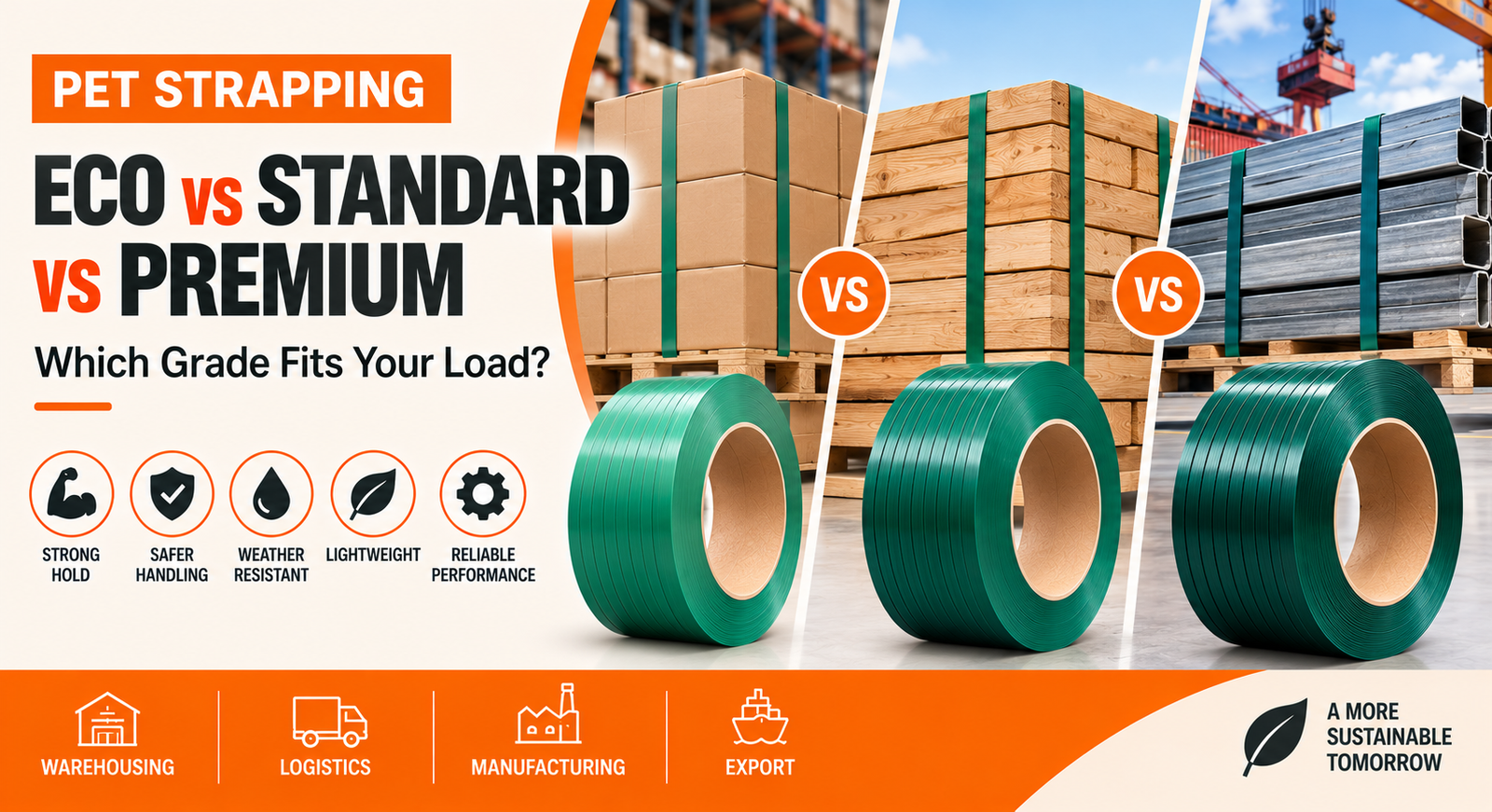
Quick answer: ECO, Standard, and Premium PET strapping grades differ mainly in tensile performance, consistency, and finish.
ECO suits lighter, cost-sensitive applications where budget matters more than maximum strength. Standard covers general pallet and warehouse work. Premium is built for heavy, export or high-risk loads where strap failure has real consequences. The right grade depends on load weight, handling conditions, and how much margin for error the job actually has.
What PET Strapping Actually Is
PET strapping, sometimes called polyester strapping, is made from polyethylene terephthalate. It’s the plastic strapping most businesses reach for when steel strapping is overkill, too dangerous to handle, or simply not worth the extra cost. PET holds tension well over time, doesn’t rust, and handles a wider range of temperatures than PP strapping without going brittle.
Compared with PP strapping, PET generally carries more load per strap width and retains tension better once applied. That’s why it’s the default for palletised timber, steel coils, bricks, and other dense, heavy goods, while PP strapping tends to sit on cartons and lighter warehouse work. If you’re not sure which material family suits your load at all, our PET strapping solutions page and PP strapping solutions page cover that split in more detail.
Within PET strapping though, grade is where most buying decisions actually get made. And it’s the part people skip past, because “strapping is strapping” until it isn’t.
Why PET Strapping Grades Exist at All
Manufacturers produce PET strapping to different specifications because not every load needs the same margin of safety, and not every business needs to pay for it. A carton of light retail stock and a bundle of structural timber for export don’t carry the same risk if the strap lets go.
Grade affects a few things directly:
- Breaking strength and how much tension the strap holds under load
- Consistency batch to batch, which matters more on automated lines
- Elongation and recovery, how well the strap keeps its grip as the load settles or vibrates in transit
- Finish (smooth or embossed), which changes how the strap performs through tensioning tools
None of that shows up on the roll itself. It shows up three weeks later, on a truck, when a load that looked fine at the dock arrives loose.
ECO PET Strapping: Where Budget and Function Meet
ECO PET strapping is the entry grade, and it’s a legitimate choice, not a compromise dressed up as one. It suits businesses moving lighter palletised goods, running high volumes where cost per strap matters, or packaging products that don’t carry major consequences if tension drops slightly over a long transit.
It’s a sensible fit for general warehousing, internal stock movement, and lower-risk export loads where the packaging job is straightforward. Where it’s not a fit: dense industrial loads, long-haul export routes with multiple handling points, or anything where a failed strap means product damage, a safety incident, or a customer complaint that costs more than the strapping ever saved.
Available in smooth and embossed finishes.
Standard PET Strapping: The Working Default
Standard PET strapping is what most New Zealand businesses run day to day. It’s the middle ground built for general pallet loads, timber bundling, manufacturing output, and export packaging that doesn’t sit at the extreme end of weight or handling risk.
It’s not a downgrade from Premium so much as a match for jobs that don’t need Premium’s extra margin. A manufacturer strapping palletised product for local or trans-Tasman freight, a distributor securing mixed cartons on a pallet, a sawmill bundling standard-dimension timber: this is where Standard earns its place. If your load weight and handling process sit within normal, predictable ranges, this is usually the correct starting point rather than the cheapest one.
Available in smooth and embossed finishes.
Premium PET Strapping: For Loads That Can’t Afford to Move
Premium PET strapping is heavy-duty PET strapping, built for jobs where failure has a real cost attached. Think steel bundles, dense timber for export packaging, palletised loads travelling long distances through multiple handling points, or anything moving through conditions where vibration and impact are guaranteed, not occasional.
The case for Premium isn’t “more strength for its own sake”. It’s that some loads genuinely need the extra tension retention and consistency, particularly when a strap is doing its job unsupervised for days on a ship or in a container. Businesses exporting timber, structural products, or heavy manufactured goods tend to standardise on Premium for exactly this reason: the strapping has to hold without anyone checking on it.
Available in smooth and embossed finishes.
Smooth vs Embossed: A Separate Decision From Grade
Smooth and embossed finishes exist across all three grades, and it’s a different question from which grade to buy. Embossed strapping has a textured surface that improves grip through friction-weld tensioning tools, which matters more on manual or semi-automated setups. Smooth strapping runs cleanly through most machine-grade equipment and is the common choice on automated lines.
Get this wrong, and the symptom looks like a strapping problem when it’s actually a tool-compatibility problem: slipping welds, inconsistent tension, and more downtime resetting straps than actually applying them.
How to Choose PET Strapping for Your Load
Work through load weight, transit conditions and consequence of failure in that order before finishing or pricing.
- Load weight and density: Heavier, denser goods push toward Standard or Premium.
- Handling exposure: Multiple forklift moves, container loading, or long transit times increase the risk a marginal grade won’t cover.
- Export vs domestic: Export loads sit unsupervised for longer and generally justify PET strapping for export packaging built to a higher grade.
- Tooling: Match embossed or smooth to the tensioning equipment already on the floor, not the other way around.
- Consequence of failure: A loose carton and a collapsed pallet of steel are not the same risk, and the strapping budget should reflect that.
Common mistake worth naming directly: buying on unit price per roll rather than cost per secured load. ECO strapping that fails once and causes a reshipped export order has already cost more than the price difference to Standard or Premium ever would have.
If you’re weighing this against a specific load and want a second opinion, that’s a five-minute conversation, not a form to fill out.
FAQs
What’s the difference between PET strapping grades?
Grades differ mainly in breaking strength, tension retention, and manufacturing consistency. ECO suits lighter, cost-sensitive jobs. Standard covers general pallet and warehouse use. Premium is built for heavy or high-risk loads, particularly export.
Is Premium PET strapping worth the extra cost?
For heavy, export or long-transit loads, generally yes, because the cost of a failed strap (damaged product, delayed shipment, reshipping) usually exceeds the price gap between grades.
Can I use ECO PET strapping for export loads?
It depends on the load. Lighter, lower-risk export shipments can work with ECO. Denser or higher-value export loads are better matched to Standard or Premium given the longer, unsupervised transit.
Does smooth or embossed strapping affect which grade I should choose?
No, finish and grade are separate decisions. Finish should match your tensioning tool; grade should match your load weight and risk.
How do I know if I’m using the wrong PET strapping grade?
Signs include strap loosening in transit, breakage during handling rather than during transport, or inconsistent tension across a batch. These usually point to an underpowered grade for the job, not a faulty roll.