
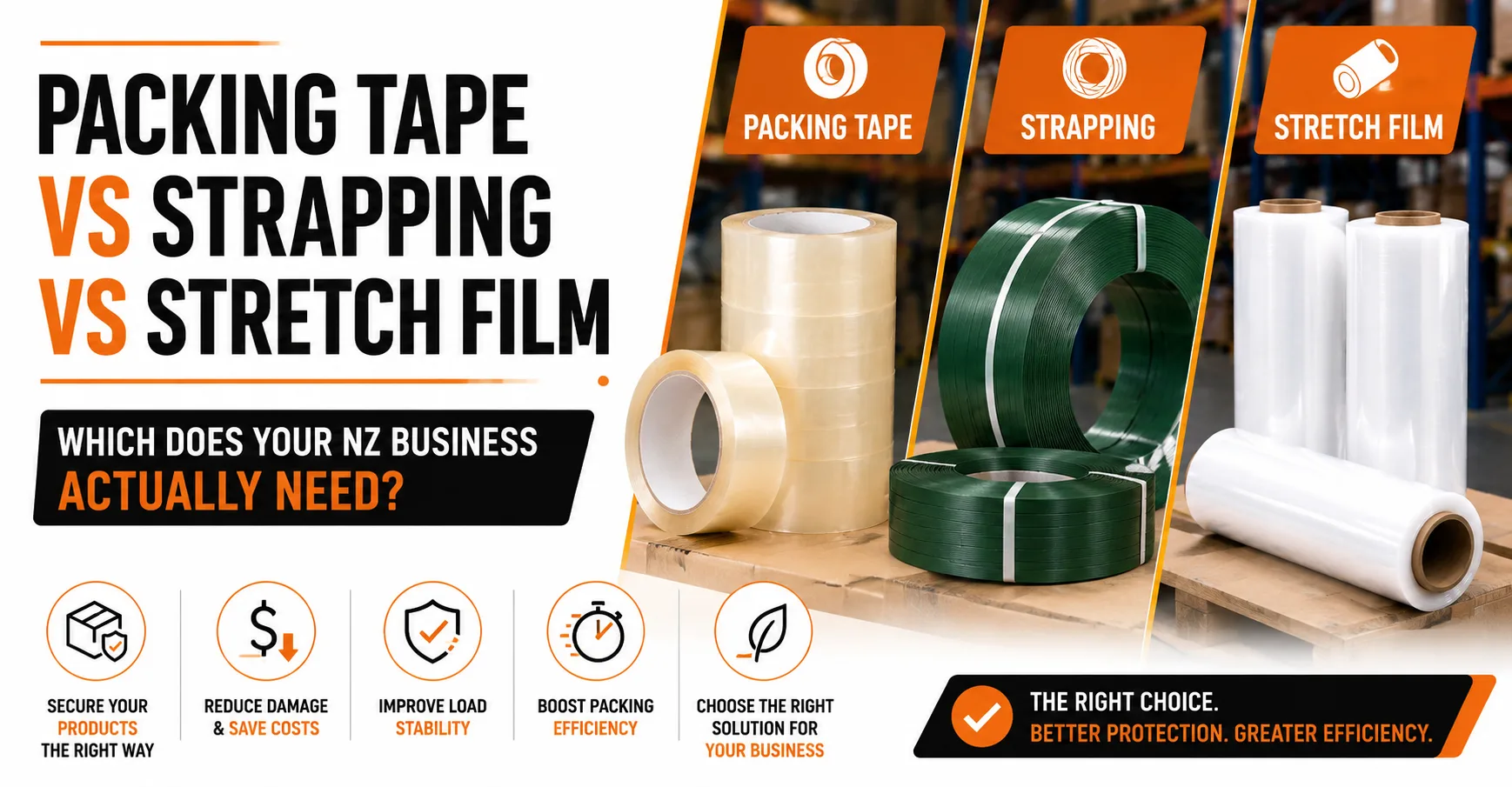
Walk into any warehouse in Auckland, Hamilton, or Christchurch and you will find a roll of packing tape sitting on someone’s desk. It is the default answer to almost every packaging question, because it is cheap, familiar, and available at every hardware store in the country. But familiar does not always mean correct. For light parcels and office mail it works fine. For pallets, export cartons, and anything that needs to survive a forklift ride and a few hundred kilometres on State Highway 1, packing tape is often the wrong tool dressed up as the easy one.
This guide breaks down where packing tape genuinely fits, where it quietly fails New Zealand businesses, and what industrial operations use instead once they outgrow the tape gun. If you are shipping pallets, bundling cartons for export, or running a warehouse where load failure means real cost, this comparison will save you a few expensive mistakes.
What Packing Tape Is Actually Good For
Packing tape, sometimes called parcel tape or carton sealing tape, is a pressure sensitive adhesive tape used to close the flaps of a cardboard box. Most rolls in New Zealand are 48mm wide polypropylene or acrylic based, sold in clear, brown, or printed finishes. It does one job well: sealing a single box so the contents do not fall out in transit.
For ecommerce sellers shipping individual parcels through NZ Post or a courier, packing tape is genuinely the right call. It is fast to apply, inexpensive per box, and widely understood by every warehouse staff member without training. If your business mostly handles single cartons going to single addresses, a good roll of packing tape and a hand dispenser will serve you fine.
Where this type of packing tape starts to struggle is scale and load. Tape adheres to the surface of a box. It does not bind a pallet together, it does not stop boxes shifting during a 12 hour freight run, and it offers no real holding force once a box is stacked, strapped, or compressed under other cartons. This is the gap most NZ packaging guides skip over, and it is exactly where strapping and stretch film take over.
Where Standard Tape Falls Short for Pallets and Bulk Freight
Ask any warehouse manager in Tauranga or Wellington what happens when a pallet shifts mid transit and you will get a story about a damaged claim, a returned shipment, or a forklift incident report. Tape simply was not engineered for this job. It has no meaningful tensile strength under load, it loosens in humidity and temperature swings common across New Zealand’s coastal regions, and it cannot bundle multiple cartons or secure a pallet to its base.
For businesses moving goods through distribution centres, exporting via the Port of Auckland or Tauranga, or running automated packing lines, the cost of using the wrong packing tape product shows up later as freight damage, rejected pallets, or repeat handling. This is the point where most growing NZ operations switch from tape thinking to strapping and wrapping thinking, because the physics of the job changes once you move from a single box to a full pallet load.
PET and PP Strapping: The Industrial Alternative to Tape
When the job is securing a pallet, bundling steel coils, timber, or bricks, or holding a stack of cartons together under tension, strapping does what packing tape cannot. PET strapping is a polyester based strap with high tensile strength and strong tension retention, built to replace steel strapping without the rust, sharp edges, or weight. It comes in smooth and embossed finishes, with embossed strapping offering extra grip and sealing reliability for high impact loads, and smooth strapping suited to consistent friction weld sealing on automated lines.
CustomPack supplies a full range here, including heavy-duty Premium PET Strapping designed for demanding load securing with excellent durability and impact resistance for industrial transport, available as Premium PET Strapping Embossed and Premium PET Strapping Smooth. For lighter and medium duty applications such as carton bundling, PP strapping is the more common choice. CustomPack’s Machine Grade PP Strapping is built for automatic and semi-automatic strapping lines and handles the bundling and pallet work that packing tape was never designed to do. Custompack
This is also where the well known terminology split matters. Hand grade and machine grade are PP strapping terms, used to describe whether the strap suits manual tools or automated machines. PET strapping is instead categorised by smooth and embossed finish. Getting this distinction right matters if you are speccing equipment or training new warehouse staff, since mixing up the terms can lead to ordering the wrong strap for your machine.
Stretch Film: Securing the Whole Pallet, Not Just the Box
Packing tape seals one carton. Stretch film secures an entire pallet load at once, wrapping cartons together so they move as a single stable unit through transport and storage. This is a different job entirely, and no amount of tape can replicate the load containment that a properly applied stretch wrap achieves.
Quality stretch film also protects against dust, moisture, and minor impacts during freight, while keeping barcodes and labels visible for scanning at distribution checkpoints. CustomPack’s stretch film range covers both hand grade and machine grade options, suited to manual pallet wrapping in smaller warehouses and high speed automated wrapping lines in larger distribution centres. For any business shipping palletised goods across New Zealand or for export, stretch film paired with strapping replaces what packing tape was being asked to do badly.
How NZ Businesses Should Choose Between Tape, Strapping, and Film
The right answer almost always depends on what you are shipping and how it travels. Single parcels going out by courier suit standard packing tape. Pallets of cartons, building materials, or stacked goods need strapping to hold tension and stretch film to contain the whole load. Heavy industrial loads such as steel coils, timber bundles, or bricks call for PET strapping specifically, since it carries the tensile strength tape cannot match.
Many warehouses across Auckland and the wider North Island actually run a mixed approach. Tape handles the outgoing parcel post, strapping secures the pallet, and stretch film wraps the load for the truck. None of these three replaces the others, they solve different parts of the same packaging chain. The mistake is relying on tape alone once your shipments scale past single box parcels, since that is exactly where freight damage claims start to climb.
If your operation is shipping more than the occasional courier parcel, it is worth reviewing whether tape is still doing a job it was never built for. CustomPack works with warehouses, logistics companies, and exporters across New Zealand to specify the right combination of PET strapping, PP strapping, and stretch film for the load type, machine setup, and freight route involved, backed by ISO 9001 and ISO 14001 certified manufacturing so the materials hold up to the claims on the spec sheet. A quick look at your current packaging spend and damage rate is often enough to show where tape is quietly costing more than it saves.
To see the full range of PET strapping, PP strapping, and stretch film options built for New Zealand warehouses and export operations, visit CustomPack.
Frequently Asked Questions
1. Is packing tape strong enough for pallets?
No, packing tape is built to seal single cartons, not hold a pallet load together. For pallets, PET or PP strapping with stretch film is the standard choice across New Zealand.
2. What is the strongest packing tape for heavy boxes?
Heavy duty polypropylene tape holds the most weight among tape types, but it still cannot match the tensile strength of PET strapping for true heavy loads.
3. What is the difference between packing tape and strapping?
Packing tape seals a box closed, while strapping holds tension across a pallet or bundle to stop movement during transport. They solve different problems and most warehouses use both.
4. Can I use packing tape instead of strapping?
Not for pallets or bulk loads, since tape has no real tensile strength once weight is applied. Strapping is required wherever loads need to stay compressed and stable in transit.
5. What size packing tape is best for moving boxes?
A 48mm wide tape is the standard size used across New Zealand for sealing moving and shipping cartons. Wider tape adds little extra strength and mainly increases cost per roll.
6. Does packing tape work in cold or humid warehouses?
Adhesion weakens in cold temperatures and high humidity, which is common in many NZ coastal warehouses. This is one reason strapping is preferred for anything stored or shipped long term.
7. How many rolls of packing tape does a pallet need?
Tape is not designed to secure a full pallet, so roll count is not really the right question. A correctly applied strap and stretch film combination replaces what several rolls of tape cannot achieve.
8. Is PET strapping better than packing tape for export shipping?
Yes, PET strapping offers far higher tensile strength and load retention, making it the standard for export pallets leaving New Zealand. Tape alone is considered insufficient for most freight and export carriers.