
Most businesses in New Zealand buy packaging supplies the same way they buy printer paper. Cheapest price. Fastest delivery. Job done.
That approach works fine until a pallet collapses mid-transit. Or a strapping roll snaps under load on the way to a container. Or a stretch film tears during storage and the entire shipment gets moisture damage.
When that happens, the question stops being about price. It becomes: did you buy your packaging supplies in Auckland from a supplier who actually had quality controls in place?
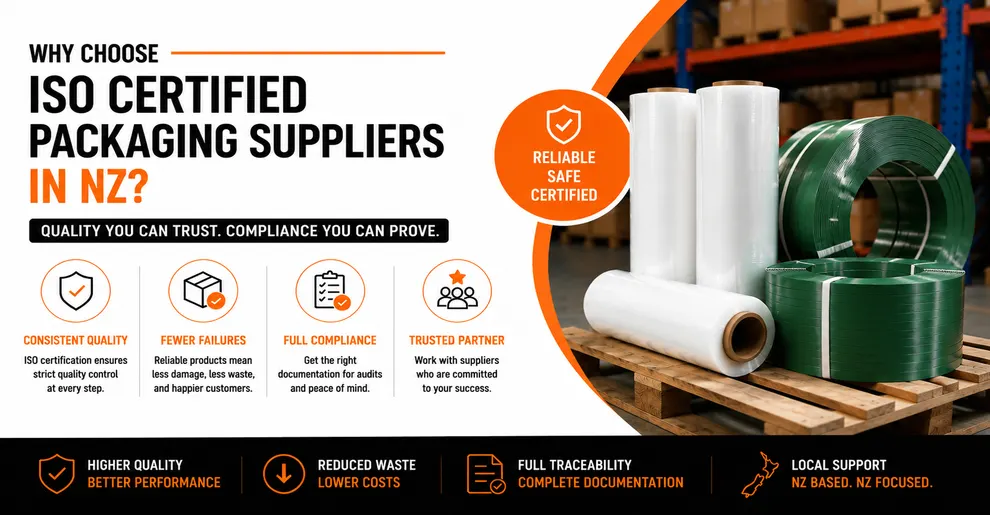
ISO certification is the clearest answer to that question. Not a guarantee of perfection, but a documented, audited, third-party verified commitment to doing things properly. This guide explains what it means, why it matters for your operation, and what to ask any packaging supplier before you spend a dollar.
What ISO Certification Actually Means for Packaging Supplies in Auckland
ISO stands for International Organisation for Standardisation. It is a globally recognised body that sets quality and environmental management benchmarks across industries.
For any Auckland packaging supplies provider, two certifications are directly relevant.
ISO 9001:2015 covers Quality Management Systems. It means the supplier has formal processes for product development, manufacturing consistency, incoming material checks, and corrective action when something goes wrong. The standard is not self-declared. It is audited by an accredited third-party body and renewed on a regular cycle.
ISO 14001:2015 covers Environmental Management Systems. It means the supplier has documented procedures for measuring and reducing environmental impact, including materials waste, energy use, and product recyclability.
Neither certificate makes a product indestructible. What they do is confirm that the supplier’s systems are structured to catch problems before the product reaches you.
That distinction matters enormously when you are buying industrial packaging supplies Auckland warehouses and logistics operations depend on, including PET strapping, PP strapping, or stretch film at volume.
Why Packaging Supplies Auckland Businesses Buy Must Meet a Higher Standard
Packaging is a deceptively high-stakes purchase. The materials themselves are not expensive. But what they protect often is.
A roll of strapping that costs $40 is holding down a pallet worth $4,000. A stretch film wrap that costs $15 is protecting a shipment going to Australia or the Pacific Islands. The failure point is never the product price. It is the downstream consequence of a failure.
This is why the packaging industry has more variation in actual product quality than buyers tend to expect. Two rolls of 12mm PET strapping can look identical and perform very differently under load. Breaking strength, elongation before failure, UV resistance, core consistency, and roll weight accuracy can vary significantly between manufacturers.
ISO 9001:2015 certification means the supplier has defined tolerances for each of these variables and tests against them. Non-certified suppliers may produce fine product most of the time, but there is no structured process ensuring consistency across every batch.
For NZ warehouse managers, logistics coordinators, and procurement teams buying packaging supplies in Auckland at volume, that consistency is not optional. It directly affects line speed, worker safety, freight claims, and product damage rates.
The Real Cost of Buying Packaging Supplies from an Uncertified Supplier
The price difference between certified and uncertified industrial packaging supplies Auckland buyers encounter often feels small at the point of purchase. The real cost comparison looks different when you include:
Product failures and repackaging time. A strapping roll that snaps during application has to be replaced and the load re-secured. At scale, this is not a minor inconvenience. It is a measurable drag on throughput.
Freight claims. Inadequate pallet wrap or inconsistent strapping strength is one of the most common causes of damaged goods in transit. Freight insurance claims take time, generate admin, and rarely recover full commercial value.
Inconsistent roll weights and dimensions. Uncertified suppliers sometimes ship rolls that are lighter or shorter than specified. Over a full year of purchasing, this can add up to hundreds of dollars in missing material without any obvious single incident to trace it back to.
Compliance exposure. Businesses exporting from New Zealand, particularly in food, agriculture, and construction materials, often have specific packaging requirements tied to their own certifications or customer contracts. Using packaging from an uncertified supplier can create gaps in your compliance documentation.
None of these costs appear on the original invoice. They appear later, and they are harder to attribute.
What to Look for When You Buy Packaging Supplies Auckland Wide
Not every supplier claiming quality will have the paperwork to back it. Here is a practical checklist for procurement teams assessing packaging suppliers in NZ.
Ask for the certificate directly. A genuine ISO 9001:2015 or ISO 14001:2015 certificate will show the issuing body, the scope of certification, and the validity period. It should be issued by an IAF accredited certification body such as SGS. If a supplier cannot produce this document quickly, be sceptical.
Check the scope of certification. A certificate for office management processes is not the same as one covering manufacturing and product quality. The scope on the certificate should specifically reference the products you are buying.
Ask about product testing. Beyond ISO, look for product-level testing such as SGS testing for stretch film, RoHS compliance for materials, or third-party breaking strength data for strapping. These are additional signals of a supplier who takes quality seriously beyond the minimum required.
Ask about private label and custom sizing. A supplier operating at genuine industrial scale will typically offer custom roll weights, widths, breaking strengths, and private branding. This is not just a commercial benefit. It indicates a manufacturing operation with real process control, not a simple reseller arrangement.
Check for environmental credentials. ISO 14001:2015 is increasingly relevant for NZ businesses with sustainability commitments or export customers who require documented environmental management from their supply chain.
How ISO Certification Affects Specific Packaging Supplies in Auckland
PET Strapping
PET strapping is used for heavy pallets, baled materials, export loads, and any application where steel strapping was traditionally used. The performance variables that matter most are breaking strength, elongation rate, and surface finish consistency.
An ISO 9001:2015 certified manufacturer will have defined tolerances for each of these across embossed and smooth variants. Premium PET strapping embossed and premium PET strapping smooth variants will be tested to specification before leaving the facility.
For buyers comparing ECO PET strapping with premium options, certification helps confirm whether the spec differences are real and consistent rather than nominal.
PP Strapping
Polypropylene strapping is widely used for lighter loads, carton bundling, and general warehouse applications. Because PP strapping is a commodity product, quality variation is common among lower-cost suppliers.
Breaking strength data and elongation consistency should be documented. For hand grade PP strapping, roll length accuracy matters particularly because operatives dispensing by hand have no machine counter to catch underweight rolls.
Stretch Film
Machine grade stretch film and hand grade stretch film both have performance variables that directly affect pallet stability: pre-stretch ratio, cling force, puncture resistance, and film thickness consistency across the roll.
SGS testing and RoHS compliance are markers worth looking for beyond ISO certification. These are relevant for NZ businesses with food-adjacent warehousing or export requirements where material safety documentation is required.
Why More Auckland Businesses Are Rethinking Where They Source Packaging Supplies
Three things have shifted buyer behaviour in New Zealand over the past few years.
First, freight costs have increased significantly. When moving a pallet costs more, the cost of a failed load increases proportionally. Buyers who once treated Auckland packaging supplies as a low-attention purchase are now scrutinising supplier credentials more carefully.
Second, export requirements have tightened. Customers in Australia, the Pacific, and international markets are more likely to ask for supply chain documentation including packaging material certification. A packaging supplier Auckland exporters rely on without credentials can create friction at the buyer’s end.
Third, sustainability expectations are real. ISO 14001:2015 is becoming a minimum expectation rather than a differentiator for businesses buying at volume. Procurement teams with ESG reporting obligations need to know their suppliers are operating to a documented environmental standard.
CustomPack: Certified Industrial Packaging Supplies Auckland Businesses Trust
CustomPack supplies PET strapping, PP strapping, and stretch film to warehouses, manufacturers, logistics operators, and exporters across New Zealand. As a fully certified packaging supplier, Auckland and nationwide customers get quality that is ISO 9001:2015 verified for Quality Management Systems and ISO 14001:2015 certified for Environmental Management Systems, with both certificates issued through SGS and IAF accredited certification bodies.
Products are SGS tested and RoHS compliant. The full range of packaging supplies in Auckland includes eco PET strapping, standard PET strapping, premium PET strapping, hand grade PP strapping, machine-grade PP strapping, hand grade stretch film, and machine grade stretch film. Custom sizing, roll weights, breaking strengths, and private label options are available with direct pricing and no minimum order gimmicks.
If your current supplier cannot produce an ISO certificate when asked, that is worth factoring into your next purchasing decision.
The Bottom Line
ISO certification does not make a packaging supplier perfect. What it does is confirm that the supplier has invested in systems, processes, and third-party oversight to produce consistent, reliable product.
For NZ warehouses and logistics operators buying industrial packaging supplies Auckland wide at volume, that consistency is the difference between a supply chain that runs smoothly and one that generates avoidable problems.
The cost of a certification gap rarely shows up on a single invoice. It accumulates over months of small failures, freight claims, repackaging time, and compliance questions that are hard to trace back to the original purchasing decision.
Buy from suppliers who can show you the paperwork. The ones who cannot usually have a reason for that.
Ready to switch to certified packaging supplies in Auckland? Browse the full range at custompack.co.nz or email sales@custompack.co.nz to discuss your requirements.
Frequently Asked Questions
1. Where can I buy ISO certified packaging supplies in Auckland? CustomPack is an ISO 9001:2015 and ISO 14001:2015 certified packaging supplier Auckland businesses rely on for PET strapping, PP strapping, and stretch film. All products are SGS tested and RoHS compliant. Browse the full range at custompack.co.nz or email sales@custompack.co.nz.
2. Why does ISO certification matter when choosing packaging supplies in Auckland? ISO certification confirms that a supplier operates under audited quality and environmental management systems. For industrial packaging supplies, Auckland buyers gain consistent product performance, accurate roll weights, documented breaking strengths, and compliance documentation, reducing freight damage and supply chain risk.
3. What is the difference between ISO 9001 and ISO 14001 for packaging suppliers? ISO 9001 covers quality management processes, ensuring products are made to consistent specifications. ISO 14001 covers environmental management. A packaging supplier holding both has documented systems for product consistency and for managing waste, energy use, and recyclability across their operation.
4. Does ISO certification apply to all products a packaging supplier sells? Not automatically. The certificate scope specifies which products and processes are covered. When sourcing packaging supplies in Auckland, always check the scope section of a supplier’s ISO certificate to confirm it includes the specific materials you are purchasing.
5. What other certifications should I look for when buying packaging supplies in Auckland? Beyond ISO 9001 and 14001, look for SGS product testing, RoHS compliance for stretch film, and third-party breaking strength data for strapping. These confirm product-level verification beyond management system compliance, which matters for warehouse safety and export documentation.
6. Can ISO certified Auckland packaging supplies help with export compliance? Yes. Many international buyers and freight certifiers require documentation confirming packaging materials meet quality and safety standards. Sourcing from an ISO certified packaging supplier Auckland exporters use means this documentation is available when customers or authorities request it.
7. How do I verify if a packaging supplier in Auckland is genuinely ISO certified? Ask for the ISO certificate directly. Confirm it is issued by an IAF accredited body such as SGS, that the validity period is current, and that the scope covers the packaging supplies you are purchasing. Any legitimate certified supplier will produce this document without hesitation.