
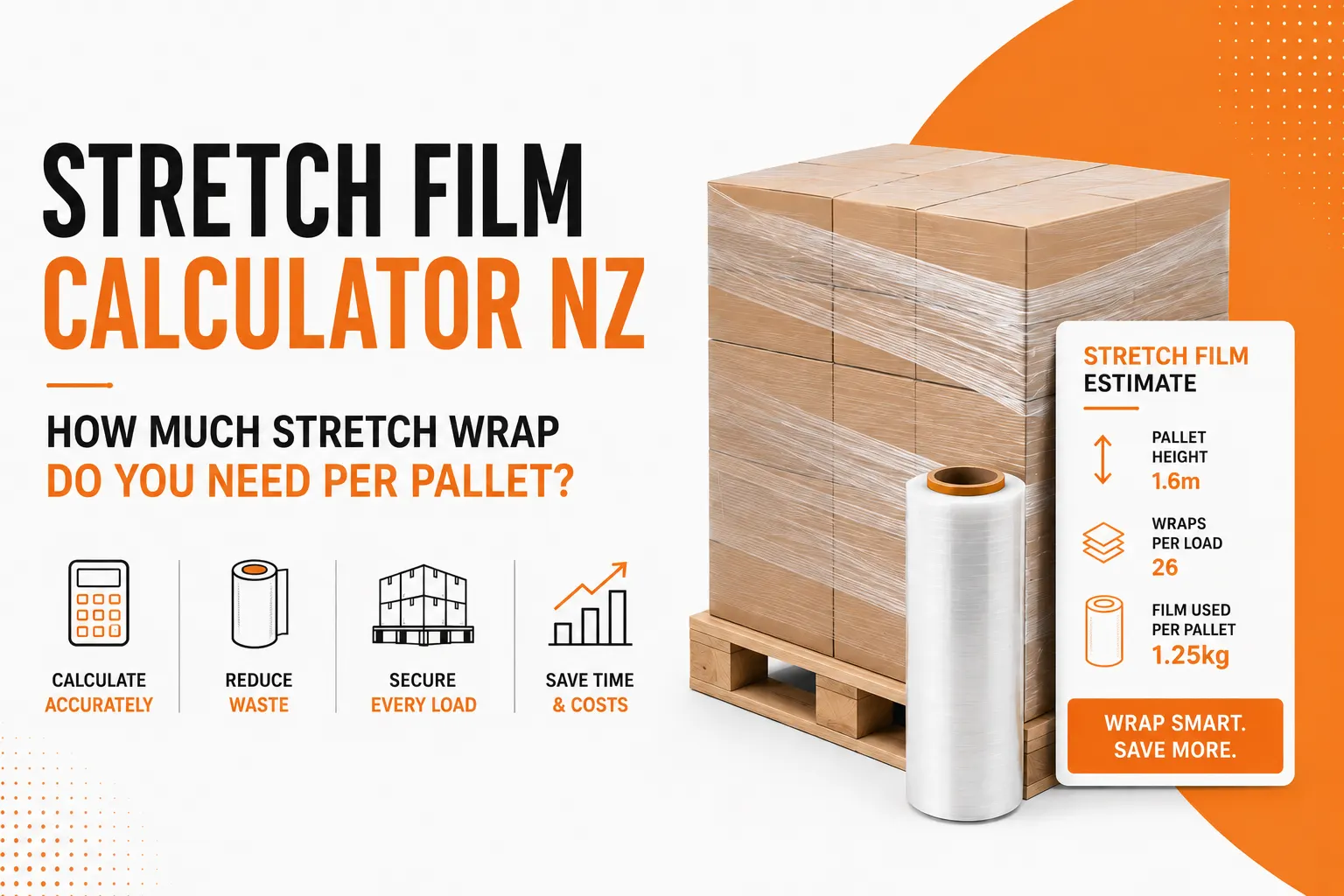
If you have ever stood in a warehouse wondering whether you are using too much stretch film or too little, you are not alone. It is one of the most common questions the team at Custompack gets asked, and honestly it is a great question. Using the wrong amount of stretch film does not just cost you money in wasted material. It can also mean unsecured loads, damaged goods in transit and frustrated customers at the other end.
So let us break it down properly. How much stretch film do you actually need per pallet, how do you calculate it, and what factors change that number depending on your load type?
Why Getting the Amount Right Actually Matters
Too little stretch film and your load shifts in transit. Boxes slide, corners get crushed and product arrives damaged. Too much and you are burning through rolls faster than you need to, adding unnecessary cost to every pallet you wrap.
In New Zealand’s warehousing and logistics sector, most businesses are either significantly over wrapping to compensate for low quality film, or under wrapping to save costs. Neither is a good outcome. The sweet spot is knowing your specific usage per pallet and optimising from there. Getting this right is something the Custompack team helps businesses across New Zealand work through regularly, and the savings are often more significant than people expect.
The Basic Formula: How to Calculate Stretch Film Per Pallet
The most straightforward way to estimate stretch film usage is by calculating the total linear metres of film applied per wrap, factoring in overlap and the number of passes.
Here is the general formula used across the packaging industry:
Film used per pallet = (Pallet perimeter x Number of wraps x Overlap factor) divided by Film width
Let us put some real numbers to this. A standard pallet in New Zealand is 1165mm x 1165mm. That gives it a perimeter of roughly 4.66 metres. If you wrap that pallet 3 times at the base, 3 times in the middle and 3 times at the top with a 50% overlap, you are looking at approximately 18 to 25 metres of film per pallet under normal conditions.
That is the baseline. The real number depends on your load, your film gauge and your wrapping technique.
Key Factors That Change How Much Film You Need
Load Weight and Stability
A light, stable load of uniform boxes stacked square needs far less film than a mixed load of irregular shapes or heavy items that shift easily. Heavier loads or unstable configurations require more passes and more film to keep everything secure.
For light and uniform loads under 200kg, you will typically use 15 to 20 metres of film per pallet. Medium loads between 200kg and 500kg generally need 20 to 30 metres. Heavy or irregular loads above 500kg will often require 30 to 50 metres or more depending on the configuration.
Film Gauge and Micron Thickness
Stretch film comes in different thicknesses, typically measured in microns. Thinner films in the 12 to 15 micron range are used for lighter loads and require more wraps to achieve adequate holding force. Thicker films in the 20 to 25 micron range provide more strength per layer so you need fewer passes.
A very common mistake is buying cheap thin film and then wrapping three times as much to compensate. You end up using more material and more labour than if you had just bought the right film in the first place. This is exactly the kind of issue Custompack helps customers identify when reviewing their packaging setup.
Hand Wrapping Versus Machine Wrapping
How you apply the film makes a significant difference to the amount you use.
Hand wrapping relies on the operator stretching the film manually. Most people stretch hand grade film to around 100 to 150% of its original length, meaning a 300 metre roll gives you roughly 450 to 600 metres of applied coverage. This varies quite a bit depending on the individual doing the wrapping, which is one reason why hand wrapping is harder to control for cost.
Machine wrapping is far more consistent. A good stretch wrapper pre stretches film to 200 to 300% of its original length, which means you get significantly more coverage per roll and far better load containment. A 1500 metre roll on a machine can deliver the equivalent of 3000 to 4500 metres of applied film. If your operation is manually wrapping more than 15 to 20 pallets a day, the cost and consistency savings from switching to machine grade film and a stretch wrapper are usually very significant.
Pallet Type and Size
New Zealand uses standard wooden pallets at 1165mm x 1165mm, but exporters may also use Euro pallets at 1200mm x 800mm or custom sizes. A smaller pallet perimeter means less film per wrap so your rolls go further. A larger or non standard pallet increases consumption. If your business regularly ships on different pallet sizes, it is worth calculating usage per size separately rather than relying on one blanket estimate.
Environmental and Storage Conditions
If your goods are being stored outside, shipped in refrigerated containers or exposed to UV, you may need UV resistant film or additional layers for protection. Cold chain environments can affect film performance, so make sure your stretch film is rated for the temperatures involved.
Quick Reference: Stretch Film Usage Estimator for NZ Standard Pallets
Use this table as a starting point based on your wrapping method and load type. These figures are based on 50% overlap and 3 to 4 passes per section across the base, mid and top of the pallet.
| Load Type | Hand Wrap (approx. metres per pallet) | Machine Wrap (approx. metres per pallet) |
| Light loads under 200kg | 15 to 20m | 10 to 15m |
| Medium loads 200 to 500kg | 22 to 30m | 15 to 22m |
| Heavy loads above 500kg | 35 to 50m | 22 to 35m |
| Irregular or unstable loads | 45 to 60m | 30 to 45m |
How Many Pallets Does One Roll of Stretch Film Cover?
This is the question that directly affects your purchasing decisions. The answer depends on your roll size and your metres per pallet usage.
Hand wrap rolls in NZ commonly come in 300m, 450m and 500m lengths at 17 to 20 micron. Dividing your roll length by your estimated metres per pallet gives you the number of pallets per roll. For example, a 450m hand wrap roll used at 25m per pallet covers approximately 18 pallets per roll.
Machine wrap rolls typically come in 1500m, 2000m or 2500m lengths. Because machines pre stretch the film, the effective coverage is much higher. A 1500m roll on a machine stretching to 250% gives you the equivalent of about 3750m of applied film, meaning at 15m per pallet you could cover 250 pallets from a single roll. This is one of the strongest arguments for machine wrapping if your volume justifies the equipment investment.
At Custompack, both hand grade and machine grade rolls are available in a range of sizes and micron ratings. If you are not sure what roll length suits your throughput, the team can help you work backwards from your daily pallet count to the most cost effective option.
How to Reduce Stretch Film Consumption Without Compromising Load Safety
Reducing film usage is not just about saving money. It is also a sustainability improvement. Less plastic used per pallet means a smaller environmental footprint across your entire operation.
Switching to pre stretch or machine grade film is one of the most impactful changes you can make. Pre stretched film is already elongated before it reaches you, so you apply less material to achieve the same holding force. Machine grade film combined with a stretch wrapper consistently delivers 20 to 30% savings in film usage compared to manual wrapping.
Using the right gauge for the job also makes a meaningful difference. Many businesses default to heavy gauge film for everything as a safety margin. Matching gauge to load type means you are not over engineering every wrap and overspending on material where it is not needed.
Training your team on wrapping technique is another area that delivers quick results. Inconsistent hand wrapping is one of the biggest drivers of film waste. A proper base rope wrap, correct overlap percentage and consistent tension throughout make a real difference to both usage and load security. For warehouse managers who want to tighten this up, it can be worth doing a simple internal review of how your team currently wraps before looking at any other changes.
For uniform and stable loads going to a single destination, combining PET or PP strapping with lighter film wrap can also reduce total material cost compared to relying on heavy stretch wrapping alone. Custompack supplies both strapping and stretch film, so if you want to explore a combined approach, the team can help you find the right balance.
What Type of Stretch Film Should You Be Using?
The best stretch film for your operation depends on your loads, your wrapping method and your throughput volume. There is no universal right answer, but here is how to think about it.
Hand grade stretch film in the 17 to 20 micron range is designed for manual application. It is softer and stretches more easily by hand, giving operators a good grip and reasonable pre stretch without a machine. Custompack’s hand grade stretch film is manufactured to consistent quality so you get reliable performance across every roll, not just the first one.
Machine grade stretch film in the 17 to 23 micron range is designed to be run at high speeds on a stretch wrapper. The film is formulated differently to handle the mechanical tension and achieve consistent pre stretch ratios of 200 to 300%. Using the right machine grade film makes a measurable difference to both load security and roll longevity.
Blown stretch film offers slightly higher puncture resistance and cling, making it well suited for loads with sharp edges or corners. Cast stretch film is clearer, quieter to unwind and more consistent in thickness, which makes it the preferred choice in most general warehouse applications.
If you are unsure which film suits your situation, it is worth talking through your load types, volumes and storage conditions with the Custompack team. Getting the right recommendation from the start saves a lot of trial and error.
Common Stretch Film Mistakes That Cost NZ Businesses Money
Buying on price alone is one of the most common issues. Cheap stretch film often has poor consistency, weak cling or lower actual stretch ratios, meaning you use more of it and still end up with poorly secured loads. The per roll price means very little without knowing the actual performance you are getting.
Not accounting for wastage is another trap. The first and last metre of most rolls is often wasted, and poor wrapping technique adds further waste. It is sensible to factor in 5 to 10% wastage when estimating roll consumption and monthly orders.
Using hand film on a machine or vice versa is surprisingly common and causes real problems. Hand grade film can snap or perform badly on a machine, while machine grade film can be too stiff to hand wrap effectively. Using the right film for the right method saves money and reduces the risk of load failures.
Wrapping too loose is perhaps the most costly mistake of all. Stretch film only works when it is under tension. Film applied loosely provides very little holding force regardless of how many layers you apply, and the load is not secure no matter how much film you have used.
A Simple Audit You Can Do Today
If you want to get a proper baseline for your stretch film usage, here is a practical approach that takes less than an hour.
Pick 10 typical pallets from your operation and mix them across your common load types. Weigh a full roll of stretch film before wrapping and after wrapping each pallet. Record the pallet weight, dimensions and load type alongside the film weight used. After 10 pallets you will have a solid average consumption figure per load type, and you will be in a much better position to estimate your monthly usage and purchasing requirements accurately.
Once you know your baseline, you can compare it against the reference figures in this article and identify whether you are in a reasonable range or whether there are meaningful savings available. Many businesses that have gone through this exercise with Custompack’s support have found they were spending significantly more on stretch film than necessary, simply because no one had ever measured it properly.
Work Out Your Stretch Film Requirements With Custompack
If you have read through this guide and want help putting the numbers together for your specific operation, Custompack is a good place to start. The team works with businesses of all sizes across New Zealand, from small warehouses dispatching a handful of pallets a day to large distribution centres processing hundreds. Whether you need hand grade film, machine grade rolls, advice on gauge selection or a review of your current packaging setup, Custompack has the product range and the practical knowledge to help.
Browse the stretch film range at custompack.co.nz or reach out to the team directly. Getting the right film at the right quantity is one of those small operational changes that adds up to a meaningful cost saving over a full year.
Frequently Asked Questions
1. How many metres of stretch film per pallet is normal?
For a standard NZ pallet with a medium load, 20 to 30 metres is typical for hand wrapping. Machine wrapping the same pallet usually requires 15 to 22 metres due to higher pre stretch ratios.
2. How do I calculate how many rolls of stretch film I need per month?
Multiply your average pallets wrapped per day by your average metres per pallet to get your daily film usage. Multiply that by working days in the month, then divide the total metres by your roll length. Add 5 to 10% for wastage.
3. What is the difference between hand wrap and machine wrap film?
Hand grade film is softer and designed for manual stretching. Machine grade film is formulated for mechanical application at high pre stretch ratios of 200 to 300%. Using the wrong type for your method reduces performance and increases cost.
4. Is thicker stretch film always better?
Not necessarily. Thicker film provides more strength but costs more per roll and adds weight. Matching gauge to load type gives you the best balance of performance and cost.
5. Can I use stretch film in cold storage or refrigerated transport?
Yes, but you should confirm the film is rated for low temperature environments. Standard stretch film can stiffen and lose cling below certain temperatures, which affects performance.
6. Where can I buy stretch film in New Zealand?
Custompack supplies stretch film to businesses across New Zealand in a range of roll sizes, micron ratings and grades for both hand and machine application. You can browse the range online or contact the team directly for a recommendation based on your specific requirements.