
A pallet arrives at the dock with a snapped steel strap curled up like a broken spring. Someone’s going to get cut retrieving it. The load’s shifted. And the steel itself cost more to buy, more to store, and more to dispose of than anyone budgeted for.
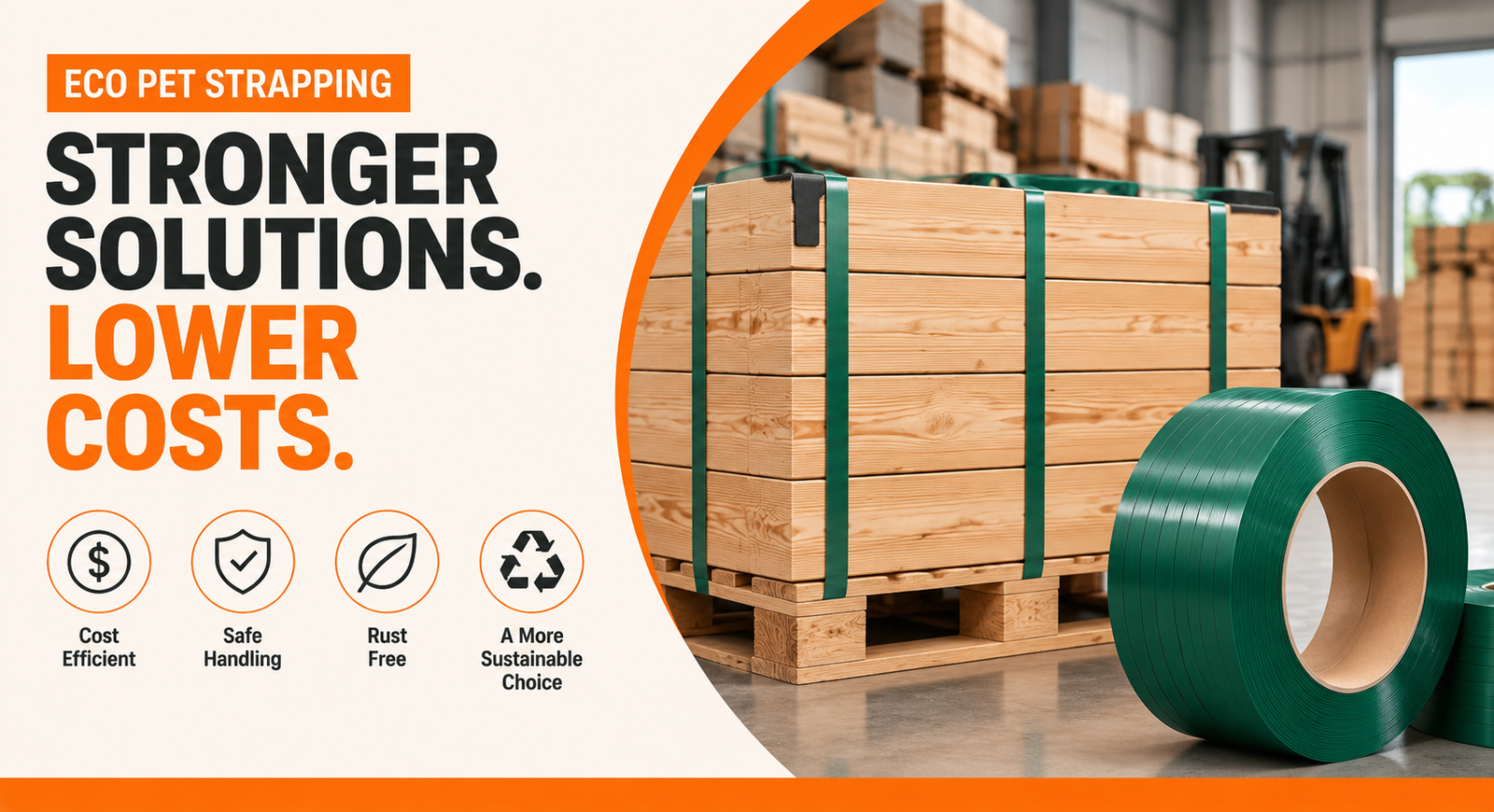
This is the exact problem pushing warehouses, sawmills, and exporters across New Zealand toward ECO PET strapping smooth. It’s not a marketing term. It’s a specific strapping product, PET (polyethylene terephthalate) strapping with a smooth surface finish, built to replace steel in applications where steel has quietly been the default for decades simply because nobody asked why.
What ECO PET Strapping Smooth Actually Is
ECO PET strapping smooth is polyester strapping with a flat, even surface rather than an embossed texture. That smoothness matters more than it sounds: it feeds cleaner through automatic and semi-automatic strapping machines, grips seals more consistently, and won’t mark or abrade sensitive product surfaces the way an embossed strap can. It’s rated for medium to heavy-duty unitising and palletising, and it holds tension without the memory loss that makes steel strap dangerous once it’s been under load for a while.
If your team is still manually tensioning steel on high-volume lines, smooth PET strapping for pallets NZ-wide is usually the first upgrade that pays for itself in reduced injuries alone.
Why Steel Is Losing Ground
Steel strapping has one advantage: raw tensile strength. That’s it. Everything else works against it in a New Zealand operating environment.
- It rusts. Coastal humidity and outdoor storage yards shorten steel’s usable shelf life, and rust stains transfer onto the product it’s supposed to protect.
- It snaps dangerously. Steel under tension that fails doesn’t just go slack. It whips. PET stretches slightly before it lets go.
- It’s heavier to freight and store. For exporters paying by container weight, every kilo of steel strap on the load is a kilo not spent on the product.
- It needs edge protectors almost every time, adding a second line item steel-strap buyers often forget to budget for.
On PET strapping vs steel strapping cost specifically, the honest answer depends on gauge, application, and current supplier pricing, so we won’t quote a blanket percentage here. What’s consistent across the industries we work with is that steel’s total cost, purchase plus replacement plus handling plus injury risk, runs higher than the sticker price suggests.
Where This Actually Gets Used in NZ
A few real cases worth naming, because generic “many industries use this” claims aren’t useful to anyone making a buying decision:
- Sawmills and lumber yards bundling timber packs, where steel has traditionally dominated but PET now handles the same tension rating with far less risk of rust staining raw timber.
- Wool bale export, an industry that’s still largely on steel strap out of habit rather than necessity. PET is a straightforward swap here, and one worth proposing if your current supplier hasn’t raised it.
- Tyre scrap bale export, same story: steel is the inherited standard, not the better product.
- Iron and steel bar bundling, concrete block manufacturing, and construction material like truss frames and aluminium products, all currently strapped with a PET/PP mix depending on load weight.
- Warehousing and distribution centres running palletised loads through automated lines, where smooth strap’s clean feed matters for uptime as much as strength.
If you’re sourcing bulk PET strapping NZ-wide for any of the above, gauge and break strength should be matched to the actual load, not assumed from whatever your last supplier stocked.
Buying Mistakes We See Constantly
- Matching strap to the old steel spec instead of the actual load weight. PET and steel aren’t interchangeable one-for-one; a proper break-strength match usually means a slightly wider or thicker PET strap, not the same number swapped across materials.
- Buying smooth strap for an embossed-only tensioner, or vice versa. Not every hand tool or machine head is compatible with both finishes. Check before you order in bulk.
- Treating “cheap PET strapping New Zealand” searches as the only decision factor. The lowest per-roll price often means thinner gauge or shorter roll length, which means more roll changes and more downtime. Price per metre of actual coverage is the number that matters.
- Skipping seal compatibility. A mismatched seal is the single most common cause of strap failure we see reported, and it’s the cheapest thing to get right.
- Not confirming dispatch timeframes before a stock-out hits. If your current supplier can’t move fast, a jammed line on a Friday afternoon becomes a Monday problem.
What to Look for in a Smooth PET Strapping Supplier
Not every smooth PET strapping supplier in NZ operates the same way. A few things worth checking before you commit to bulk ordering:
- Certification that’s actually verifiable. CUSTOMPACK holds ISO 9001:2015 (quality management) and ISO 14001:2015 (environmental management), both issued by SGS, not a self-declared badge.
- Genuine 24-hour NZ-wide dispatch, not “same day where possible.”
- Stock depth across gauges, so a sudden order increase doesn’t mean a six-week wait.
- A team that can talk you through eco friendly packaging strapping NZ options honestly, including what’s confirmed and what isn’t. If a supplier promises a specific recyclability percentage without paperwork behind it, that’s worth questioning.
CUSTOMPACK’s ECO PET strapping smooth range is stocked in the gauges most commonly used across warehousing, export, and manufacturing, and sits alongside the wider PET strapping product range for teams comparing smooth against embossed or PP alternatives.
If you’re ready to move off steel or just want the right gauge confirmed for your load, get in touch and we’ll match the strap to the job, not the other way round.
FAQs
Is ECO PET strapping smooth stronger than steel?
No, steel has higher raw tensile strength. PET’s advantage is in total handling safety, weight, and rust resistance, not peak strength per millimetre.
Can I use smooth PET strapping in an automatic strapping machine?
Yes, for most machines. Confirm your machine head is rated for smooth finish before switching, since some tensioners are embossed-specific.
What’s the difference between smooth and embossed PET strapping?
Embossed has a textured surface for extra grip in some manual applications. Smooth feeds more consistently through automated lines and reduces surface marking on sensitive loads.
Does CUSTOMPACK dispatch bulk PET strapping orders fast?
Yes, CUSTOMPACK offers 24-hour dispatch NZ-wide on stocked strapping products.