
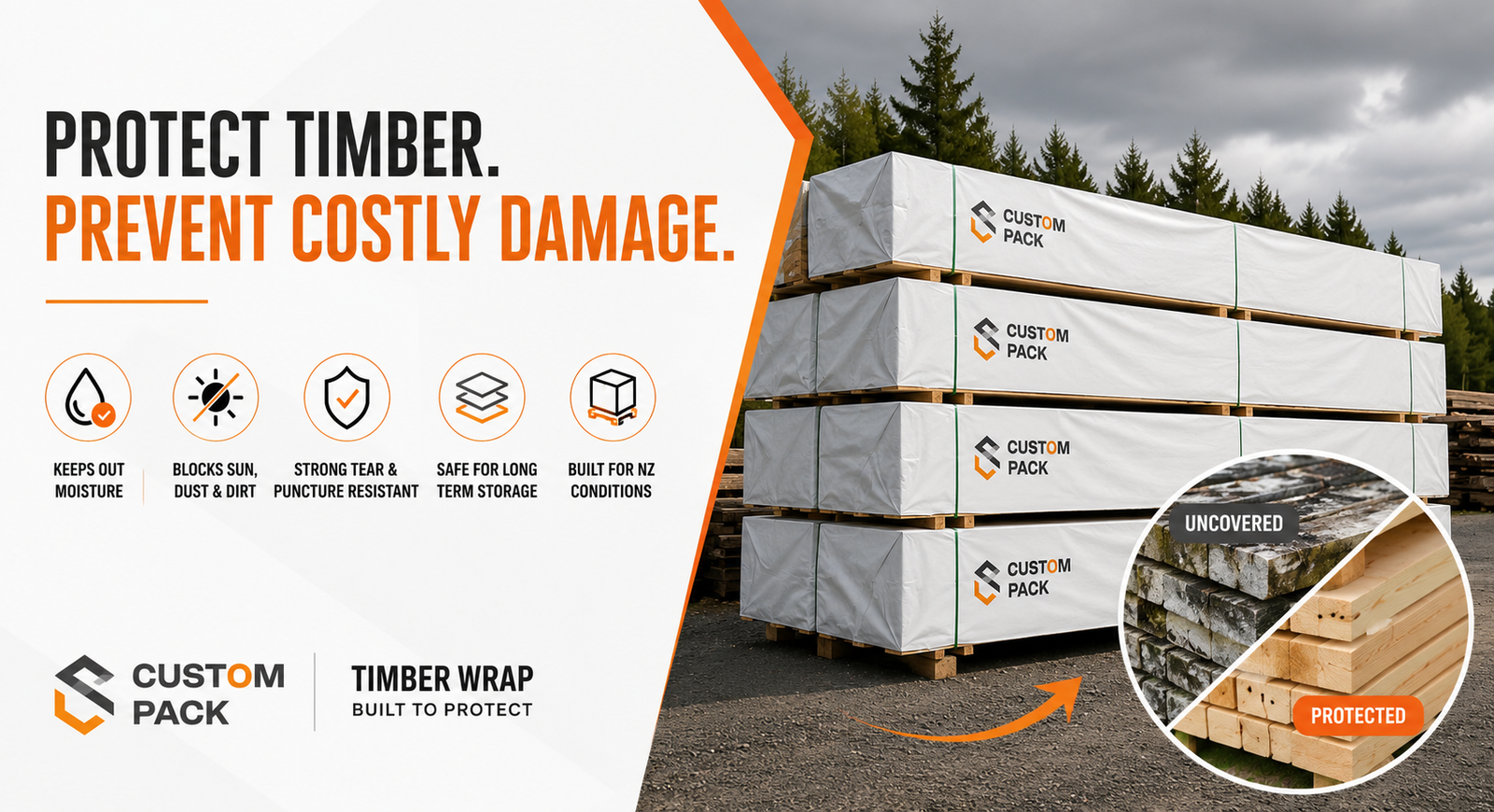
Walk past any building site after a wet week and you’ll spot it fast: a stack of framing timber gone grey at the edges, corners swelling, the top few boards already cupping. Nobody meant for that to happen. It’s just what happens when timber sits uncovered on-site longer than planned, which in New Zealand’s climate is almost always.
Timber protection isn’t an afterthought you tack on before dispatch. It’s the difference between lumber that arrives and stores exactly as milled, and lumber that’s been quietly degrading since the day it left the yard.
What Actually Happens to Uncovered Timber
Wood is porous. That’s obvious once you say it, but it’s easy to forget when a stack looks fine from a distance. Moisture doesn’t need rain to get in either; humidity swings, morning dew, and condensation under a tarp that’s trapping damp air all do the job just as well.
Once moisture gets into the grain, three things start happening at once:
- Swelling and warping as fibres absorb water unevenly across the board
- Surface discolouration, usually a grey or blue-black staining from mould and fungal growth
- Weakened structural integrity, particularly at joints and cut ends where end grain soaks up water fastest
None of this needs weeks. Framing timber left exposed through a single wet weekend can show visible staining by Monday. And once mould has taken hold, sanding it off doesn’t fix the strength loss underneath; it just hides it.
Dust is the quieter problem. On a construction site or in an open yard, dust settles into the same grain that’s absorbing moisture, and the two combine into a grime layer that’s hard to shift without damaging the surface. For anything destined for a visible finish, that’s a real cost, not a cosmetic footnote.
The Cost Nobody Puts on the Quote
Here’s where uncovered timber storage actually bites: it’s rarely one clean loss. It’s a chain.
Damaged boards get rejected on-site or during export inspection. Rejected boards mean reordering, which means delays. Delays push back builds, and on commercial jobs that can mean penalty clauses or lost trust with a client who’s now watching the schedule slip. None of that shows up on the original timber invoice, but it’s all downstream of the same uncovered stack sitting in the yard.
We won’t put a dollar figure on it here. Every site’s exposure, timber grade, and storage duration are different, and a made-up percentage helps nobody. What we can say plainly: the cost of proper timber wrap is a fraction of the cost of replacing rejected boards, and it’s paid once, not repeatedly every time a stack sits out in weather it wasn’t built for.
Why On-Site Storage Is the Real Risk Window
Most timber protection conversations focus on transit, and fair enough, freight is where damage is visible and easy to photograph. But on-site storage is often the longer exposure window, and it gets far less attention.
A stack sitting at a lumber yard or a sawmill for two days before dispatch is one thing. A stack sitting on a building site for two weeks because the framing crew got delayed is another. Construction schedules move. Weather doesn’t wait for them.
Good on-site storage practice means:
- Keeping stacks off the ground on dunnage or bearers, never direct contact with wet ground or concrete
- Covering the full stack, not just the top layer, since side and end exposure causes just as much damage
- Allowing airflow where possible rather than sealing timber that’s still curing or drying
- Checking wrap integrity if timber sits longer than originally planned, particularly after any wind event
That last point matters more than people expect. A wrap that was fine on day one can shift, tear, or loosen by day ten if nobody’s checked it.
What Good Timber Wrap Actually Needs to Do
Not all wrap is equal, and the gap shows up exactly when you need it least: mid-storm, three weeks into a job that was meant to take one. The properties that matter for wood protection in NZ conditions:
- High tensile strength: Timber stacks are heavy, have sharp edges, and get handled roughly by forklifts and manual crews alike. Wrap that tears on the first snag isn’t protecting anything by week two.
- Tear resistance: Related to tensile strength but distinct: a wrap can resist a straight pull and still fail against a puncture from a protruding nail or a sharp board corner. Both properties need to hold.
- Weather sealing: The wrap needs to shed water at seams and overlaps, not just resist it on the flat surface. Poor sealing at joins is where most on-site failures start.
- Dust protection: For export timber, especially, a clean surface on arrival matters as much as a dry one. Wrap that keeps dust out during long yard storage protects the finish, not just the moisture content.
This is where CUSTOMPACK’s timber wrap earns its place. It’s built for the combination NZ sites actually deal with: rough handling, extended storage, and weather that doesn’t stick to a forecast. And for suppliers who want their branding visible on every stack that leaves the yard, custom printing is available, so protection and brand presence aren’t separate purchases.
Export Packaging Adds Another Layer
If timber’s heading offshore, the exposure window gets longer and the stakes get higher. Export packaging has to survive port handling, container loading, sometimes weeks at sea, and a second round of exposure on arrival before it’s even unwrapped.
A wrap that holds up for three weeks of domestic storage isn’t automatically fit for six weeks of export transit. The tear resistance and seal quality that felt like overkill on a local job become the baseline for anything crossing the Tasman or further.
Exporters we talk to tend to underestimate one thing: humidity inside a sea container can spike well above ambient conditions once the sun hits the roof. Wrap that’s marginal on land can be genuinely inadequate once it’s sealed inside a container for the crossing.
Talk to CUSTOMPACK about timber wrap built for NZ storage and export conditions, including custom-printed and size options for your brand.
FAQs
What’s the best way to protect timber stored outdoors in NZ?
Keep timber off the ground on dunnage, wrap the full stack including base and ends, and check wrap integrity if storage runs longer than planned.
How long can timber sit uncovered before it’s damaged?
Visible discolouration can appear within days in wet or humid NZ conditions, and moisture damage can start even sooner at cut ends and joints.
Does timber wrap stop mould and discolouration?
Yes. Properly sealed wrap covering the full stack, including the base, greatly reduces moisture exposure, the main driver of mould and grey staining.
Is timber wrap different from standard stretch film or pallet wrap?
Yes. Timber wrap is built for tensile strength, tear resistance and weather sealing over long storage, unlike standard stretch film or pallet wrap.
Can timber wrap be custom printed for branding?
Yes. CUSTOMPACK offers custom-printed timber wrap, so suppliers can protect stock and keep branding visible on every stack leaving the yard.