
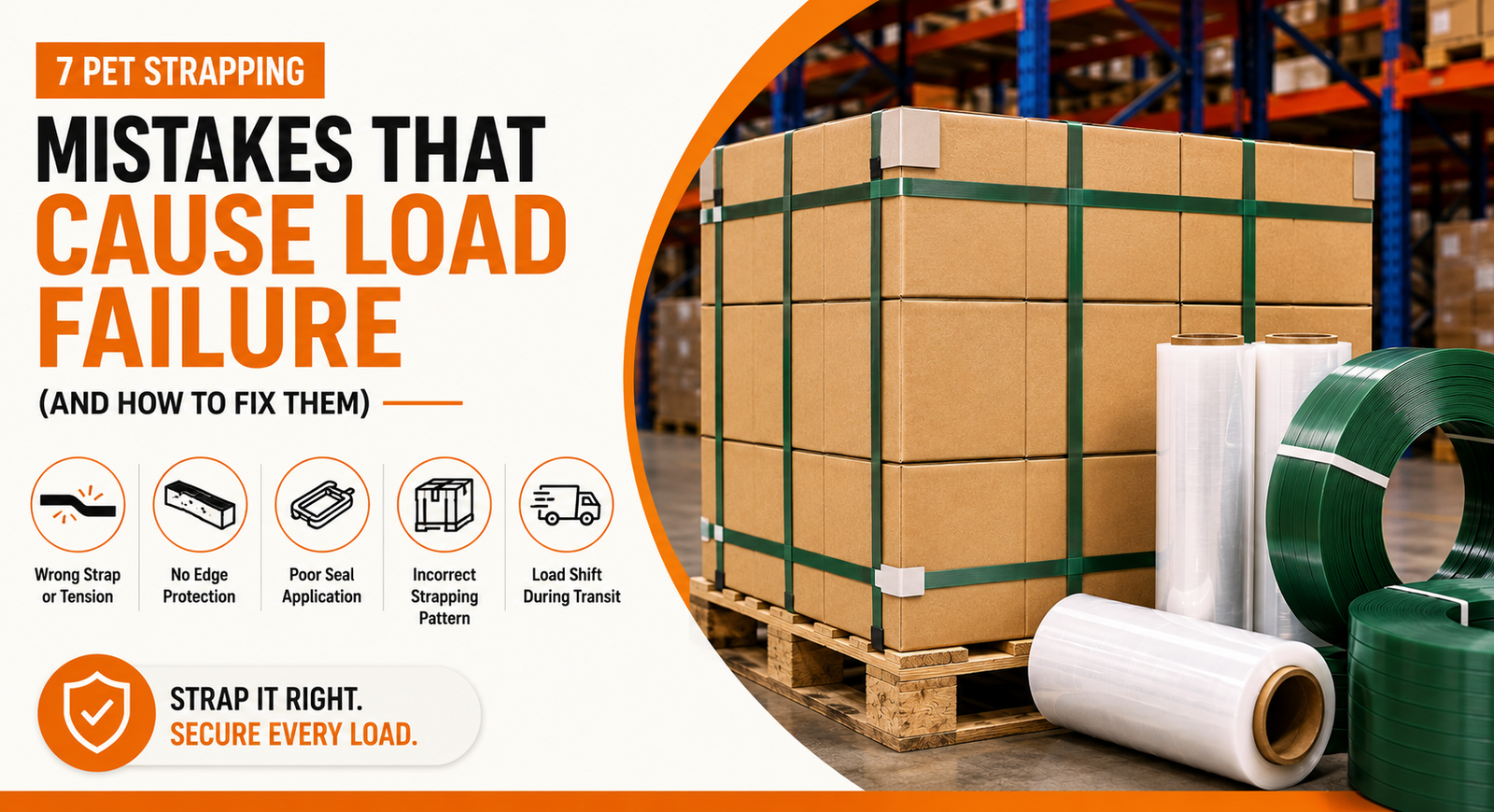
A pallet leaves the warehouse tight and square. It arrives at the port, or the customer’s dock, leaning, loose, or half unwrapped. Nothing about the product changed. The strapping did.
Load failure rarely comes down to one dramatic cause. It’s usually a small, repeatable mistake made at the strapping station, the kind that goes unnoticed until a shipment arrives damaged and someone has to explain why. For businesses moving goods across New Zealand, from sawmills dispatching lumber to exporters palletising scrap metal, these PET strapping mistakes show up more often than most operations realise, and most are fixable without buying new equipment.
This isn’t a list of obvious advice. It’s the specific, practical failure points CUSTOMPACK sees across construction, food manufacturing, and export operations, and what actually fixes each one.
1. Using the Wrong Strap Grade for the Load
Incorrect strap selection is the root cause behind a surprising share of load failures. A strap rated for light cartons won’t hold a pallet of concrete blocks or steel bar. It stretches under weight it was never built for, and stretch under load is the first step toward breakage in transit.
Match the strap to the actual weight, not the average weight. A mixed pallet with a few heavy items and several light ones still needs strapping rated for the heaviest realistic load, because tension doesn’t distribute evenly across a pallet. It concentrates where the load bulges.
CUSTOMPACK’s ECO, Standard, and Premium PET strapping grades are built for different load weights, so the fix usually starts with checking which one is actually on the strapping cart.
2. Getting Tension Wrong in Either Direction
PET strap tension problems cut both ways. Too loose, and the load shifts the moment the truck brakes hard. Too tight, and the strap can crush product edges, deform packaging, or snap under its own tension before the truck even leaves the yard.
Strapping tension errors are often a training gap, not an equipment fault. Operators using manual tools tend to undertension out of habit, while battery-powered tools set too aggressively can overtension without the operator noticing until product damage shows up downstream. The fix is calibrating tension to the product, not to what “feels right,” and checking it periodically rather than assuming the tool setting is still correct after months of use.
3. Skipping Edge Protectors on Sharp or Uneven Loads
Edge protection mistakes are one of the most avoidable causes of strap breakage. Steel plate, aluminium products, and stacked timber all have edges sharp enough to cut into a strap under tension. Without an edge protector, the strap doesn’t fail gradually. It fails at the exact point of contact, often mid-transit, with no warning.
Corner protectors solve the same problem for softer or more compressible products, spreading pressure across a wider surface instead of letting it concentrate at a single point.
- Sharp metal or timber edges: use an edge protector at every strap contact point
- Compressible or fragile goods: use corner protectors to prevent crushing
- Mixed loads: check every strap line individually, not just the obvious edges
4. Poor Seal Application
Poor seal quality strapping is rarely about the seal itself. It’s almost always about how it was crimped. A seal that’s under-crimped slips under tension over time. One that’s over-crimped can weaken the strap right at the seal point, which becomes the failure spot instead of holding the load.
This matters more on longer transport routes, where vibration works on a weak seal for hours rather than minutes. A seal that looks fine leaving the dock can fail somewhere between Auckland and a South Island distribution centre if it wasn’t crimped correctly in the first place.
5. Strapping in the Wrong Position or Pattern
Pallet strapping mistakes often come down to placement, not just tension. Straps running only around the pallet’s outer edge do little to stop a load from shifting internally. Loads with awkward shapes, mixed cartons, or stacked layers need cross-strapping or a pattern that actually pins the load together, not just around it.
Pallet load security depends on straps sitting where the load will actually move, which means checking each pallet’s shape rather than applying the same strap pattern to every load out of habit.
6. Ignoring How the Load Will Move in Transit
Load shift during transport happens for reasons that have nothing to do with the strap’s tensile strength. Braking, cornering, and uneven road surfaces all put lateral force on a load that vertical strapping alone doesn’t fully control.
This is where a lot of operations lose the plot. They strap for how the load looks sitting still, not how it behaves at 90km/h with a truck braking hard. A load that’s secure in the yard can still shift on the highway if the strapping pattern only accounts for downward weight.
7. Not Matching Strap Width and Thickness to the Job
Strap breakage causes usually trace back to one of two things: wrong grade, or wrong dimensions. A narrower strap concentrates the same tension over less surface area, which increases the chance of snapping under stress even if the tensile strength rating looks adequate on paper.
What This Actually Costs
Every one of these mistakes is fixable at the strapping station, not the warehouse floor plan. Most operations don’t need new equipment. They need the right strap grade, correct tension, edge protection where it’s actually needed, and a seal that’s crimped properly the first time.
If your loads are arriving loose, damaged, or shifted more often than they should, it’s worth reviewing your current strapping and packaging setup with someone who can spot which of these seven mistakes is actually happening on your line. Talk to CUSTOMPACK about the right strapping setup for your load type.
FAQs
Why does PET strapping snap even when it’s rated for the load?
Breakage usually comes from a secondary issue, not the strap’s rated strength. Sharp edges without protectors, poor seal crimping, or overtension can all cause a correctly rated strap to fail before it reaches its actual breaking point.
How tight should PET strapping be?
Tight enough to hold the load firm with no visible movement, but not so tight it deforms the product or the strap’s own edges. The right tension varies by product, which is why a fixed tool setting across every job often causes problems.
Do I need edge protectors on every pallet?
Not every pallet, but any load with sharp or hard edges, timber, steel, concrete block, or stacked metal, needs them at every contact point where the strap meets that edge.
What’s the most common cause of load shift in transit?
Strapping that accounts for downward weight but not lateral force from braking or cornering. Cross-strapping or a pattern suited to the load’s actual shape addresses this better than uniform outer strapping.