
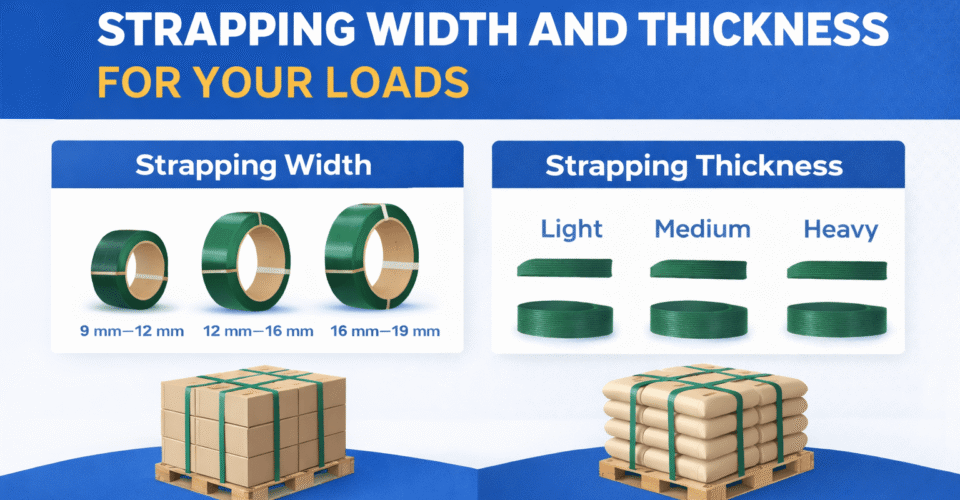
Choosing the correct strapping width and thickness is important for securing loads safely during storage and transport. Strapping helps keep cartons, pallets, and bundled goods stable while they are moved through warehouses, trucks, and distribution centres. If the strap is too narrow or thin, it may break under tension. If it is too heavy for the load, it increases packaging costs without improving performance. Selecting the right size ensures better load stability, safer transport, and more efficient packaging operations.
Why Strapping Size Matters
Strapping width and thickness determine how much tension the strap can handle and how effectively it stabilises the load. Wider straps distribute pressure across a larger area, while thicker straps provide greater tensile strength and durability.
Using the correct strapping size provides several benefits:
• Improved pallet stability during transport
• Reduced product movement and damage
• Better packaging efficiency
• Safer handling in warehouses and logistics operations
For example, lighter packaging tasks often use Hand Grade PP Strapping, while automated packaging lines rely on Machine Grade PP Strapping for consistent tension and smooth machine feeding.
Understanding Strapping Width
Strapping width refers to the measurement across the strap’s surface. Wider straps provide greater holding power and better load distribution, making them suitable for heavier or larger pallets.
Common strapping widths include:
• 9 mm – 12 mm: Suitable for light packaging such as cartons, retail products, and small bundles.
• 12 mm – 16 mm: Ideal for medium-weight pallets and warehouse shipments.
• 16 mm – 19 mm: Used for heavy-duty industrial packaging and export shipments.
Choosing the correct width ensures the strap can distribute tension evenly and maintain load stability.
Understanding Strapping Thickness
Thickness refers to the gauge of the strap material and directly affects the strap’s break strength and resistance to impact. Thicker straps can withstand higher tension and are commonly used for heavy-duty applications.
Key advantages of thicker strapping include:
• Higher tensile strength
• Better resistance to stretching
• Improved load retention during long-distance shipping
For example, heavy pallet loads often require thicker Premium PET Strapping, while lighter warehouse packaging may use thinner Hand Grade PP Strapping or Machine Grade PP Strapping.
Matching Strapping Size to Load Weight
The type and weight of the load should guide your choice of strapping size. Light packages and cartons usually require narrower straps, while heavy pallets need wider and thicker straps to maintain stability.
General guidelines include:
• Light loads: 9 mm to 12 mm polypropylene strapping
• Medium loads: 12 mm to 16 mm PP or PET strapping
• Heavy loads: 16 mm to 19 mm PET strapping for stronger load retention
Selecting the correct size ensures that the strap provides adequate support without unnecessary material usage.
Choosing the Right Strapping Material
Different materials provide different levels of strength and flexibility. Polypropylene (PP) strapping is commonly used for light and medium loads because it is flexible and economical. Hand Grade PP Strapping and Machine Grade PP Strapping are widely used in warehouses, retail packaging, and logistics environments.
Polyester (PET) strapping offers higher strength and better tension retention. Solutions such as Standard PET Strapping, Eco PET Strapping, and Premium PET Strapping are ideal for securing heavier pallets and industrial shipments where stronger load containment is required.
Manual vs Machine Strapping
Another factor to consider is whether the strapping will be applied manually or with machines.
Manual strapping is typically used in smaller packaging operations and works well with lighter loads. It is commonly applied using hand tensioners and seals.
Machine strapping is designed for high-volume packaging lines. Automatic and semi-automatic machines require consistent strap thickness and width to ensure smooth feeding and sealing.
Signs You May Need Stronger Strapping
Sometimes packaging failures indicate that the current strap size or type is not strong enough. Signs that stronger strapping may be required include:
• Straps breaking during transport
• Loads shifting on pallets
• Excessive stretching when tensioned
• Loose straps after shipping or storage
In such cases, upgrading from lighter strapping to stronger options such as Standard PET Strapping or Premium PET Strapping can significantly improve load stability.
Final Thoughts
Choosing the correct strapping width and thickness plays an important role in protecting goods during transportation and storage. The right strapping should match the load weight, packaging method, and equipment used in the packaging process.
Solutions such as Hand Grade PP Strapping, Machine Grade PP Strapping, Eco PET Strapping, Standard PET Strapping, and Premium PET Strapping provide reliable options for different packaging needs. By selecting the appropriate strapping type and size, businesses can improve load security, reduce packaging failures, and maintain efficient logistics operations.