
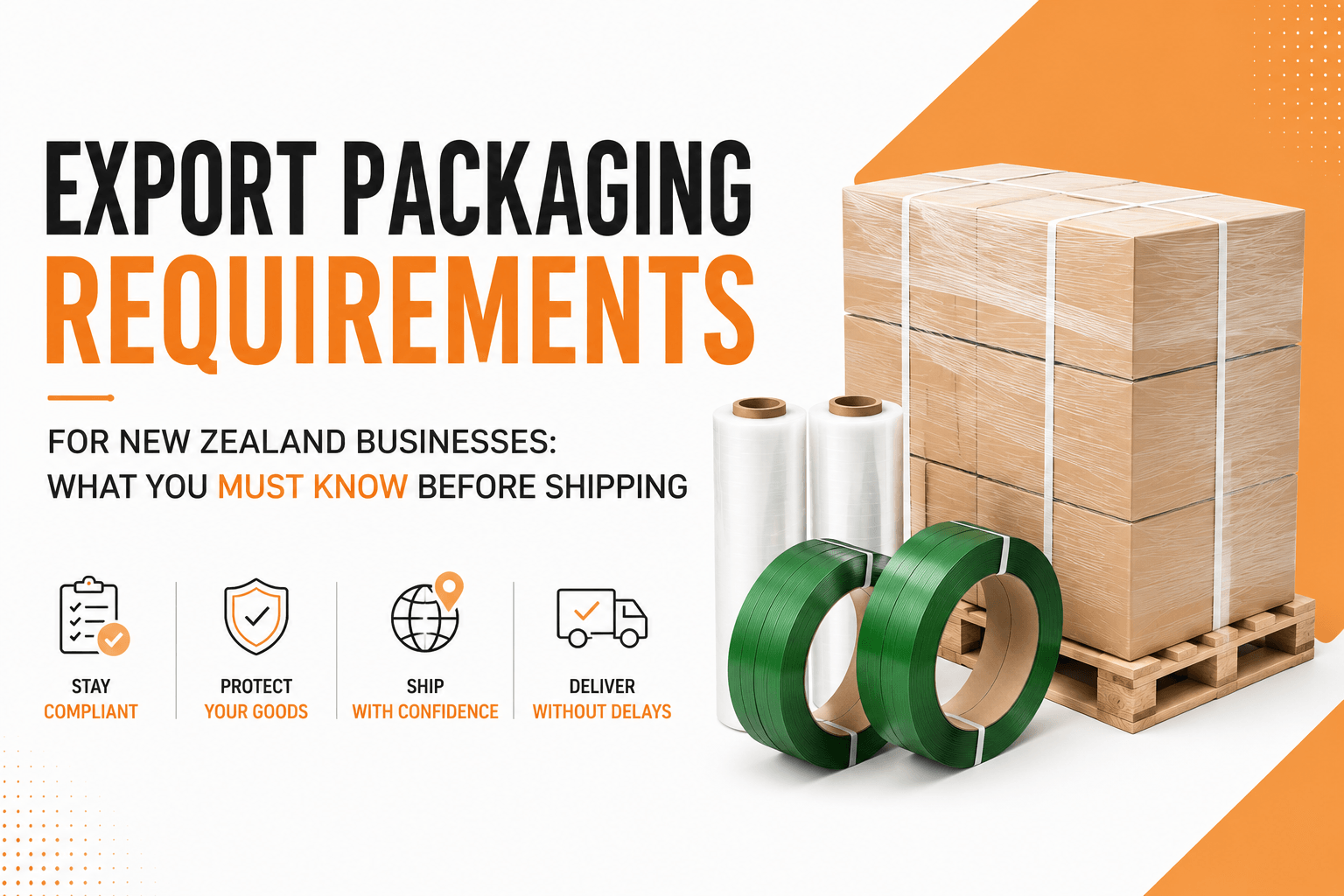
Let’s be honest. Most exporters spend months doing the hard work correctly. You find the right buyers, spend weeks negotiating terms, sort out the freight forwarder, and get everything lined up. Then one shipment comes back or gets stuck at a foreign port, and when you dig into what went wrong, it has nothing to do with your product quality or your pricing or your paperwork. The packaging failed.
That scenario plays out more often than people in the industry like to admit. And the frustrating part is that it is almost always preventable.
In 2026, packaging compliance for New Zealand exporters covers far more ground than it used to. It is not simply a matter of putting your goods into a box and wrapping the pallet before the truck arrives. The requirements now touch on load stability, biosecurity regulations, destination country standards, material certifications, and how your freight behaves after days or weeks inside a shipping container on the open ocean. Getting across these requirements is not optional anymore. It is the foundation of running a reliable export operation.
This guide is written for New Zealand businesses that are serious about getting it right.
What Export Packaging Requirements Actually Involves
There is a version of this topic that gets oversimplified into a checklist, and then there is the reality of what happens inside a supply chain once your goods leave the warehouse. Understanding the difference matters a lot.
When a pallet exits your facility, it might travel by truck to a port, sit in a container stack for days, spend three weeks crossing the Pacific, get unloaded by machinery at a foreign terminal, travel again by road, and finally be inspected by customs before reaching your buyer. At every single stage, your packaging is being tested in ways you cannot see or control.
The export packaging requirements New Zealand businesses are expected to meet today address each of those stages. Load stability matters because containers shift constantly at sea. Moisture resistance matters because temperature and humidity inside a container fluctuate significantly. Correct labelling matters because customs officers in another country need to process your goods without ambiguity. Timber packaging certification matters because many countries will reject or quarantine shipments that arrive on uncertified wooden pallets.
None of these things are complicated once you understand why they exist. The problems come when exporters treat packaging as an afterthought rather than as part of the overall freight strategy.
The Real Reason Good Products Arrive in Bad Condition
Here is something worth sitting with for a moment. A shipment can leave your facility in perfect condition and still arrive at your buyer looking like it was dropped down a flight of stairs. The product inside might be completely fine. But the packaging tells a different story.
This is not a rare edge case. It is one of the most consistent issues reported across international freight operations. Loads shift inside containers. Cartons that were stacked correctly at origin collapse under the movement and pressure of a long ocean voyage. Film that looked tight on the pallet becomes loose once the load settles and the temperature changes.
The international shipping packaging requirements that importers now demand from their suppliers are a direct response to this problem. Buyers on the receiving end of damaged shipments want to know, before they place an order, that the exporter has packaging systems capable of protecting goods across the full journey. Not just from the warehouse to the truck, but across every leg of the trip.
There is also a less obvious dimension to this. Your packaging is the first physical thing your overseas customer touches. Before they open the carton and inspect the product, they have already formed an impression based on how the packaging looks when it arrives. A well secured, professionally presented pallet communicates that you take your business seriously. A damaged, poorly wrapped load communicates the opposite, regardless of what is inside.
Why PET Strapping Has Become the Standard for Export Freight
Among the packaging materials that have seen the biggest shift in adoption over recent years, PET strapping sits near the top of the list.
For a long time, steel strapping was the default choice for heavy export loads. It is strong and widely understood, but it comes with real drawbacks. Steel is rigid. When a load shifts or a container flexes during transit, steel strapping does not flex with it. It either holds perfectly or it fails suddenly. It is also heavy, prone to corrosion, and can cause serious injuries during application and removal.
PET strapping, also known as polyester strapping, offers tensile strength that genuinely competes with steel while behaving in a fundamentally different way under stress. Because it has elasticity built into its structure, it absorbs the shocks and vibrations that are a constant part of international freight. When the container rolls on a swell or the truck hits a rough patch of road, PET strapping gives slightly and then returns tension rather than snapping or losing its grip on the load.
That physical characteristic makes it particularly well suited to long distance export freight where the stresses on a pallet are cumulative over time rather than just a single impact event.
Industries that have adopted PET strapping as a standard for export pallets include timber and building materials, agricultural exports, beverage and bottling operations, manufacturing equipment, and bulk packaged goods. For timber in particular, where pallet loads are heavy and export journeys can span weeks, PET strapping has largely replaced steel as the preferred option.
If you are still using steel strapping on your export freight and you have experienced any load movement or damage in transit, it is worth having a look at what PET strapping would mean for your operation.
Understanding When PP Strapping Is the Better Fit
Not everything you export is heavy, and not every packaging job requires the performance specifications of PET. For a significant range of applications, PP strapping is the more practical and economical solution.
Polypropylene strapping has been a reliable workhorse across warehousing, retail, food manufacturing, and general freight operations for decades. It is flexible, easy to work with, available in a wide range of sizes and strengths, and costs less per metre than PET.
Where PP strapping genuinely excels is in applications involving lighter loads, carton bundling, retail ready packaging, and general warehousing tasks. If you are securing boxes of consumer goods, bundling products for display, or stabilising lighter pallets before domestic or short haul freight, PP strapping handles those jobs efficiently without the cost overhead of a higher performance product.
The practical decision between PET and PP strapping comes down to two questions. How heavy is the load, and how far is it travelling? Heavy loads on long international routes need PET. Lighter loads on shorter journeys are typically well served by PP.
Getting this decision right is not just about compliance. It is about not spending more than necessary on packaging materials while also not cutting corners where the load actually needs the stronger product.
Stretch Film and Why So Many Pallets Fail Because of It
Ask freight operators who handle international shipments what they see go wrong most often, and a large number of them will tell you it comes down to the wrapping. Not the product, not the pallet, not even the strapping. The stretch film.
Stretch film is one of those packaging materials that looks simple from the outside. You wrap the pallet, and you are done. But there is a meaningful difference between a pallet that has been wrapped correctly and one that has simply been covered in plastic.
When stretch film is applied well, with enough layers, at the right tension, and extended down to lock the load to the pallet base, the whole unit behaves as one solid object during transit. That is what you want. The entire pallet moves together, which means nothing inside shifts, collapses, or topples.
When stretch film is applied loosely, with too few passes, or with the wrong gauge film for the weight of the load, you end up with individual cartons that are merely touching each other inside a plastic sleeve. The first time the container makes a sharp movement, things start to shift.
Choosing the best stretch film for international shipping requires thinking about a few specific factors. Load weight is one of them because heavier pallets need a higher gauge film to maintain containment. Transit distance matters because longer journeys mean more accumulated stress on the wrapping. Storage conditions at destination matter because goods sitting in hot, humid environments need film with appropriate resistance properties.
For businesses running high volumes through their packing operations, machine stretch film provides consistency and efficiency that hand wrapping simply cannot match. The tension and coverage are applied uniformly every time, which matters a great deal when you are putting hundreds of pallets through the system each week. For smaller operations or irregular loads, hand stretch film gives you flexibility without requiring capital investment in machinery.
How to Build a Pallet That Actually Survives International Shipping
Pallet packaging for overseas shipping works best when you think about it as a layered system rather than a series of separate tasks. Each component supports the next, and the goal throughout is to create a load that functions as a single stable unit from the moment it leaves your facility to the moment it reaches your buyer.
The foundation is the pallet itself. A damaged, undersized, or non compliant pallet creates problems before the load has moved a metre. If you are shipping to markets with specific pallet dimension requirements, make sure your pallet matches before you start stacking product.
Once the load is built on the pallet, strapping comes next. For heavier export freight, PET strapping applied both horizontally and vertically gives you the containment needed for long distance transport. For lighter loads, PP strapping applied correctly does the same job at a lower cost.
After strapping, stretch film is applied to lock the whole load together and provide protection from moisture and contamination during transit. Multiple layers, extended down to the pallet base, make the difference between a pallet that moves as a unit and one that slowly comes apart.
For loads involving products with corners or edges that are vulnerable to strapping pressure, edge protectors distribute the force across a wider surface area and significantly reduce carton crushing. They are a small addition that makes a noticeable difference on freight where presentation at destination matters.
The Packaging Mistakes That Cause the Most Problems at the Border and Beyond
Most exporters are diligent about their documentation. Customs paperwork, certificates of origin, phytosanitary certificates, all of it gets attention. What often gets less attention is the physical condition of the packaging, and that is where problems quietly build up.
Weak or recycled cartons are among the most common culprits. Secondary cartons that were not rated for the weight of the load placed inside them will fail under the stacking pressure experienced during a long voyage. Replacing them with correctly rated cartons costs very little compared to the cost of a damaged shipment.
Under wrapping is another problem that shows up constantly. Pallets that have been wrapped without adequate layers or without locking film down to the base are significantly more likely to experience load movement during transit. The film gives the impression of security without providing the actual containment.
Incorrect pallet dimensions create problems at destination. Some countries and some buyers have strict requirements about pallet sizing, and arriving with non compliant pallets can trigger inspection processes that delay delivery and add cost.
Non compliant timber packaging is a particularly serious issue for exporters using wooden pallets or crates. The ISPM 15 standard exists because untreated timber can carry pests and pathogens across borders, and many countries enforce it strictly. Arriving with uncertified wooden packaging can result in fumigation requirements, shipment holds, or outright rejection. If you are using timber packaging of any kind, make sure it is certified.
Finally, damaged or missing labels create clearance problems. Labels that are applied to surfaces that flex during transit, or that are not protected from moisture, frequently become unreadable. Customs officers who cannot clearly read your documentation have no choice but to flag the shipment for further processing.
Investing in proper packaging from the start addresses all of these problems. Browse Custompack’s complete range of export packaging products to find the right materials for your operation.
Packaging Requirements Vary Across Industries and It Matters That You Know Yours
There is no single packaging formula that works equally well for every type of export freight. Agricultural products have different requirements from manufactured machinery. Food exports have different requirements from building materials. Understanding what your specific freight needs is part of running a compliant and professional export operation.
Agricultural exporters shipping fresh or processed produce face particular challenges around moisture management. Products may be in transit for two or three weeks, and humidity inside a container can vary significantly. Stretch film that provides moisture resistance combined with PET strapping for load stability is a common foundation for agricultural export packaging.
Food manufacturers have additional considerations around hygiene and contamination. PP strapping is widely used in food production environments because it is clean, flexible, and compatible with food safe handling practices. Choosing packaging materials that meet hygiene requirements relevant to your market is part of export packaging solutions NZ food businesses need to get right.
Timber and building product exporters deal with the specific challenge of heavy, dense, and often awkwardly shaped loads that are highly susceptible to shifting. PET strapping at higher tension ratings, combined with edge protectors and robust stretch film, is typically the most reliable combination for this type of freight.
Industrial manufacturers exporting large or heavy machinery components often need custom packaging approaches. High strength strapping, purpose built crating, and protective wrapping tailored to the specific dimensions and fragility of the product all form part of the solution.
If you are not certain what combination of materials is right for your freight, the team at Custompack can help you work through the specifics.
Why New Zealand Exporters Are Taking Packaging More Seriously Than Ever
A few years ago, packaging was still something that many exporters treated as a cost to be minimised. If the goods arrived mostly intact, the packaging had done its job well enough. That mindset has shifted considerably, and a number of factors are driving the change.
Freight costs have increased substantially, and when a shipment is damaged or delayed, the cost of resolving it compounds quickly. There is the replacement or reworking of damaged goods, the expedited shipping to meet a deadline, the relationship management with a buyer who received something they did not expect. Every one of those costs is avoidable with better packaging upfront.
Customer expectations have also shifted. Buyers in international markets, particularly those dealing with premium or high value goods, have become less tolerant of delivery problems. A single damaged shipment is a complaint. Two or three becomes a pattern that affects how buyers perceive your reliability as a supplier.
Regulatory requirements are tightening in many destination markets. Biosecurity rules, sustainable packaging mandates, and timber certification requirements are not becoming simpler over time. Exporters who stay ahead of these requirements avoid being caught out when new rules come into force.
Businesses that approach packaging as an investment rather than an expense consistently experience fewer damage claims, fewer compliance issues, and stronger long term relationships with their international customers. The returns on getting packaging right are real and measurable.
Export Packaging Products Available Through Custompack
Finding packaging products that are genuinely suited to export freight rather than general warehousing makes a significant difference in how your loads perform over long distances.
At Custompack, New Zealand exporters have access to a full range of industrial packaging products built around the demands of international freight. The range includes PET strapping for heavy load containment across long distance routes, PP strapping for lighter applications and carton bundling, machine stretch film for high volume wrapping operations, hand stretch film for flexible and smaller scale packaging environments, and edge protectors for loads where corner and carton protection is needed.
Whether your operation is shipping goods domestically or sending containers to markets in Asia, Europe, North America, or further afield, having the right packaging materials in place reduces risk at every stage of the supply chain. Browse the full product range at Custompack or reach out to the team directly to talk through what your specific export packaging operation needs.
Where Export Packaging Is Headed
The direction of export packaging over the next several years is clear enough. Stronger materials, more efficient systems, and increasing pressure to move toward sustainable and recyclable options are all shaping how exporters approach their packaging decisions.
Regulation is not getting simpler. Biosecurity requirements, environmental standards, and material compliance rules are being tightened in markets around the world. Exporters who build compliance thinking into their packaging systems now will be better placed to adapt as those requirements evolve.
Technology is also playing a growing role. Better monitoring of load behaviour during transit, improved testing of packaging systems before shipments leave, and smarter material choices are all part of how leading exporters are reducing damage and improving consistency.
But underneath all of that, the fundamental truth remains the same as it has always been. Products that are packaged well arrive safely. They satisfy customers. They protect the reputation of the business that shipped them. That is the real value of taking packaging seriously, and it does not change regardless of where the regulations go next.
Frequently Asked Questions
1. What are the export packaging requirements in New Zealand?
Export packaging must protect your goods throughout every stage of the freight journey and meet the regulatory requirements of the destination country. The core areas to focus on are load stability, moisture and impact protection, correct and durable labelling, and certified packaging materials. For any shipments that involve wooden pallets or crates, ISPM 15 certification for timber packaging is a specific requirement in many destination markets.
2. Why is PET strapping used for export pallets?
PET strapping combines high tensile strength with the ability to absorb shocks and vibrations during transit. Unlike steel strapping, which is rigid and can fail suddenly under stress, PET strapping maintains tension by flexing with load movement and then returning to its original state. This makes it highly reliable for heavy freight on long international routes.
3. What is the difference between PET strapping and PP strapping?
The main difference is in their performance characteristics under load. PET strapping is designed for heavy loads that require strong, sustained containment across long journeys. PP strapping is better suited to lighter products, carton bundling, and general packaging applications where the demands on the strapping are less intense. Choosing the right one depends on your product weight and how far it is travelling.
4. What is the best stretch film for international shipping?
The answer depends on the specifics of your operation. For businesses running high packing volumes, machine stretch film provides consistent tension and coverage that improves load integrity across the board. For smaller or more variable packaging environments, hand stretch film gives you the flexibility to wrap different load sizes effectively. Heavier loads and longer journeys generally call for a higher gauge film with stronger containment properties.
5. How do I secure a pallet for overseas shipping?
Effective pallet packaging for overseas shipping works as a layered system. You start with a correctly rated pallet, apply appropriate strapping using either PET or PP depending on your load weight, wrap with quality stretch film extended down to lock the load to the pallet base, and add edge protectors for vulnerable corners. The goal is a load that behaves as a single stable unit rather than individual components that can shift independently during transit.
6. Can poor packaging cause customs delays?
Yes, and it happens more frequently than most exporters expect. Unstable or damaged loads, unreadable labels, incorrect pallet dimensions, and non compliant timber packaging materials are all common triggers for customs inspections, holds, and additional processing requirements. These delays add cost and create friction with buyers at destination.
7. Why does packaging compliance matter for exporters?
It directly protects your revenue, your customer relationships, and your reputation in international markets. Well packaged freight arrives intact, clears customs smoothly, and satisfies the buyer who receives it. Poorly packaged freight creates damage claims, delays, complaints, and in some cases the permanent loss of a customer who decides there are more reliable suppliers available. Treating packaging as a strategic part of your export operation rather than a variable cost to be minimised pays off consistently over time.