
Last month, a business owner in Auckland told me his team packed a pallet perfectly. They followed their usual packaging checklist, stacked everything neatly, wrapped it in film, and labelled it correctly. But the pallet was still rejected at the depot because the strapping gave way in the truck. Three days of delays, a damage claim, and an unhappy customer. The packing looked right. But it was not right enough.
Shipping in New Zealand is not forgiving. Your goods travel by road, by ferry across the Cook Strait, sometimes by air. By the time a pallet reaches its destination it may have been moved by four different sets of hands across three different facilities. Every one of those moves is a test your packaging either passes or fails.
This checklist is for anyone who ships goods in New Zealand, whether that is a few courier parcels a week or full pallets going to the other side of the country or into an export container. Work through it before every shipment and you will avoid most of the problems that cause damage, delays, and unexpected costs.
What Every NZ Shipper Gets Wrong Before They Even Start Packing
Most packaging mistakes are made before anyone touches a roll of tape. These are the things to sort out first.
You need to read your carrier rules before you pack, not after. NZ Post, Mainfreight, Toll, CourierPost, and every other carrier in New Zealand has its own set of rules about what packaging they will accept. Some of those rules surprise people. Carriers are within their rights to refuse a shipment that does not meet their requirements, and in most cases the freight charge still applies. Read the rules for your specific carrier and keep them somewhere you can find them.
Weight and size matter more than most people realise. Carriers charge by volumetric weight, which means a large lightweight box can cost more to send than a small heavy one. Get proper scales and measure your boxes accurately every time. Getting this wrong either costs you money on billing corrections or gets your shipment held until you pay the difference.
Not every box is strong enough for what you are putting in it. A standard single wall carton from the supermarket is built for holding groceries on a shelf, not for being thrown onto a truck. For anything heavy, use double wall cartons. For anything sharp edged, use triple wall. Buy proper shipping cartons, not whatever was sitting in the recycling. Businesses shipping fragile, oversized, or high-value goods may benefit from custom packaging solutions designed for better protection during transport.
Dangerous goods have their own rules entirely. Batteries, aerosols, paint, adhesives, cleaning products, and a lot of other everyday items are classified as dangerous goods under New Zealand transport law. If any of your products fall into that category, the packaging and labelling requirements are completely different. Talk to your carrier before you book. Not on the day the truck comes.
Packaging Checklist for Courier Parcels in New Zealand
This covers anything going via a standard courier service, boxes, bags, tubes, whatever the format.
The box needs to be bigger than the item. Leave at least 50mm of space between the item and every wall of the box. That space gets filled with cushioning. If the item is touching the walls of the box, the box is not doing its job.
Wrap every fragile item on its own. Not as a group. Each piece separately. Use bubble wrap, foam wrap, or thick packing paper. Once wrapped, each item should be able to sit in the box without touching any other item or any wall. If anything can knock against anything else, wrap more.
Pack it tight enough that nothing moves. Fill every gap with packing peanuts, air cushions, or scrunched paper. Pick up the closed box and shake it firmly. If you can feel or hear movement inside, open it and add more fill. A parcel that passes the shake test has a good chance of surviving a courier van.
Tape it properly. Use 50mm wide packing tape, not office tape or masking tape. Run a strip down the centre seam of the lid, then one strip along each short edge seam. Do the same on the bottom. That is six strips of tape minimum. For heavier boxes, run an extra strip around the sides of the box as well.
Print the label and protect it. A handwritten label that gets wet and smears is how parcels end up lost. Print the label, stick it flat on the largest side of the box, and put a layer of clear tape over it. Write your return address on the opposite side or bottom of the box.
Remove every old barcode and label. If you are reusing a box, scanner systems at courier depots can read an old barcode and send your parcel to a completely different address. Peel them off or cover them fully. This takes ten seconds and can save you a week of trying to find a missing parcel.
Pallet Packaging Checklist for NZ Freight
Pallets are where most businesses have the most to lose. A poorly packed pallet can damage other people’s freight, injure a forklift operator, and cost you thousands in claims. Get this part right.
Pick the Right Pallet
The standard NZ pallet is 1165mm x 1165mm. You will also see 1200mm x 800mm and 1200mm x 1000mm depending on the industry. Whatever size you use, your goods need to sit inside the pallet footprint, not hang over the edges. Overhanging loads get hit by forklifts, scrape against other pallets in transit, and are refused by some carriers.
Check the pallet itself. A cracked board or a missing block is not a minor issue on a heavy load. If a pallet looks rough, do not use it for anything you cannot afford to lose.
Stack the Load Correctly
Heavy boxes at the bottom, light boxes at the top. This is basic physics and a lot of businesses still get it wrong. Stacking a heavy carton on top of a light one crushes the light one by the time the truck has gone ten kilometres.
Stack in a column or an offset brick pattern. Columns are stable when the stack is even. Brick pattern offsets the layers and adds a bit more lateral stability. Either works as long as the stack is level and square.
Put a layer board between every two rows of cartons if the stack is going more than three rows high. It spreads the load and stops the bottom cartons getting crushed under pressure over a long journey.
Nothing overhanging. No single box sticking out at the top. No leaning. Square it up before you strap it.
Strap It So It Cannot Move
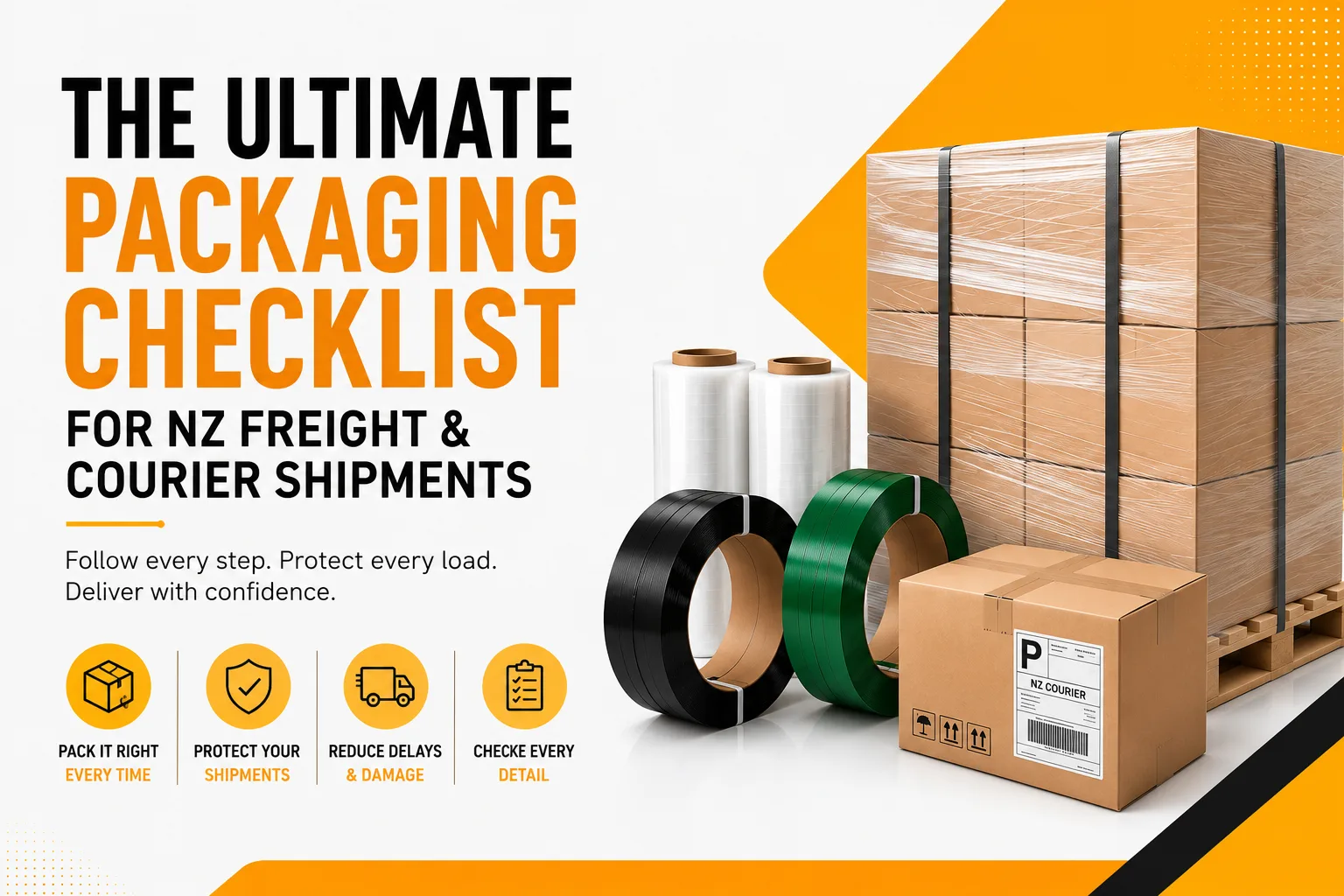
Strapping is what turns a stack of boxes into a load. Without strapping, vibration and movement in transit slowly loosen everything and the whole thing collapses. With the right strapping applied correctly, the load moves as one solid piece.
For most general freight pallets, PP strapping does the job well. It is cost effective, flexible, and works with manual tensioners or automatic strapping machines. Custompack’s PP strapping comes in both hand grade and machine grade across a range of widths and breaking strengths.
For heavy pallets, export loads, or anything going into rough handling conditions, PET strapping is the better choice. It keeps its tension under load for longer than PP strapping, absorbs impact rather than snapping, and is far safer than steel strapping because it does not spring back as a sharp edge when cut. Custompack’s PET strapping is available in eco, standard, and premium grades depending on the load you are securing.
Minimum four straps per pallet. Two going lengthwise, two going widthwise. For anything tall or heavy, add more. Run them tight enough that there is no slack anywhere in the strap.
Wrap the Whole Thing in Stretch Film
Strapping holds the load together. Stretch film protects it. Wrap the full pallet from the bottom up, anchoring the film around the base of the pallet first before working your way up. Overlap each pass by at least half the film width. Do the full height at least three times over. Tuck the tail flat at the top.
Hand stretch film works for smaller operations. If you are wrapping several pallets a day, machine stretch film saves time and wraps more consistently than doing it by hand.
Once the pallet is wrapped, the label needs to be visible through the film. Do not wrap over the label. Put it on last or leave a window in the wrapping.
Export Packaging Checklist for Goods Leaving New Zealand
Exporting adds a whole other layer of requirements. The journey is longer, the conditions are harder, and the rules at the other end are different from anything you deal with domestically.
Timber packaging must be ISPM 15 treated. This is not negotiable for international shipments. Wooden pallets, crates, and any other timber packaging used in exports from New Zealand must carry the IPPC mark confirming it has been heat treated or fumigated. If it does not have that mark, customs at the destination can hold your shipment, treat the timber at your cost, or send the whole thing back. Check every pallet before it gets loaded.
Sea freight means moisture is your enemy. Containers go through temperature changes on long voyages that cause condensation to form inside them, even when the doors are shut. That moisture gets into your cartons. Use moisture resistant packaging on the outside, put desiccant sachets inside the cartons, and make sure your stretch film wrap is complete with no gaps.
Add corner protectors and edge boards before you wrap. Standard carton corners compress and fail under the weight of other cargo stacked on top in a container. Corner protectors and full height edge boards give the pallet a rigid outer frame that can actually handle being loaded under a few tonnes of other freight.
All your paperwork needs to be on the outside of the pallet. When customs or biosecurity wants to see your documentation, they are not going to wait for you to unpack the load to find it. Put everything in a documentation pouch and attach it to the outside of the pallet. Label every carton with the contents, country of origin, and consignee details. Make it easy for inspectors to find what they need without breaking your load open.
Packaging Mistakes That Are Costing NZ Businesses Real Money
These come up again and again. If any of them sound familiar, they are worth fixing.
Strapping a pallet with one strap. It looks like something is holding the load together. It is not. One strap in one direction on a full pallet of mixed cartons will loosen within the first hour of road travel. Use four minimum and use the right grade for the weight.
Choosing stretch film by price alone. Thin film on a heavy load tears. You end up applying more of it to compensate, which costs more than buying the right gauge in the first place. Match the film weight to the load.
Packing to the weight limit and then some. Carriers measure and weigh at the depot. If your declared weight is wrong, you get a correction invoice and sometimes a delay while it is sorted. Weigh everything before you book.
Reusing damaged boxes. A box that got wet and dried out again has lost most of its structural strength even if it looks okay. A corner that has been crushed once will fail again under pressure. When boxes look tired, replace them.
Sending anything expensive without a return address. Delivery labels fall off. They get wet. They get scanned incorrectly. Without a return address on the box itself, a lost parcel stays lost.
Where to Get Reliable Packaging Supplies for NZ Freight
If you are shipping freight regularly, the quality of your packaging materials matters as much as how you use them. Strapping that snaps at the wrong tension or stretch film that tears on the first wrap is not a saving, it is a liability.
Custompack supplies PET strapping, PP strapping, and stretch film to warehouses, logistics operations, manufacturers, and exporters across New Zealand. Their products are manufactured to ISO 9001:2015 and ISO 14001:2015 standards and independently tested and certified through SGS. You can order in the size, grade, and specification that actually suits your freight rather than making do with whatever the nearest hardware store has in stock.
Full Packaging Checklist: Print This and Use It
Before Every Shipment
- Read your carrier’s packaging requirements
- Weigh and measure goods accurately before booking
- Select the right carton or pallet for what you are sending
- Check dangerous goods status if relevant
Courier Parcels
- At least 50mm of cushioning space on all sides
- Each fragile item wrapped individually
- No movement when box is shaken firmly
- 50mm tape in H pattern on top and bottom
- Printed label covered with clear tape on largest surface
- Return address on outside of box
- All old barcodes and labels removed or covered
Freight Pallets
- Pallet in good condition, correct size for the load
- Heavy goods at base, light goods at top
- Layer boards between rows on tall stacks
- Nothing overhanging the pallet edges
- Corner protectors fitted
- Minimum four straps, two lengthwise and two widthwise
- Full stretch film wrap from base to top of load, three passes minimum
- Label visible through stretch film
Export Shipments
- ISPM 15 stamped timber throughout
- Moisture barrier materials and desiccant sachets inside cartons
- Corner protectors and full height edge boards fitted
- Heavy duty PET strapping applied firmly
- Complete stretch film wrap with no gaps
- Documentation pouch attached to outside of pallet
- All cartons labelled with contents, origin, and consignee
Final Thoughts
Packaging is one of the last things most businesses think about and one of the first things that causes a problem. Every damage claim, every rejected pallet, every delayed shipment has a packaging decision somewhere at the start of it. Get the checklist in front of your team and use it every time. The few minutes it takes is a lot cheaper than what goes wrong when you skip it.
Frequently Asked Questions
1. What packaging is required for NZ courier shipments?
Your parcel needs a strong sealed carton with cushioning so nothing moves inside, proper packing tape in an H pattern on the top and bottom, a printed label with clear tape over it, and a return address on the outside.
2. What is the maximum weight for a courier parcel in New Zealand?
Most NZ couriers accept parcels up to 25kg to 32kg. Anything over that needs to go via a freight service.
3. Do I need stretch film on a freight pallet?
Yes. Stretch film holds the whole load together, keeps moisture and dust off the goods, and makes the pallet safe to move with a forklift. Most freight carriers expect it.
4. What is the difference between PP strapping and PET strapping for freight?
PP strapping suits lighter loads and general warehouse packing. PET strapping is stronger, holds its tension longer, and handles heavy pallets, rough conditions, and export freight far better.
5. Do wooden pallets need special treatment for exports from NZ?
Yes. All wooden packaging in an international shipment from New Zealand must be ISPM 15 treated and carry the IPPC mark. No mark means risk of being stopped at customs.
6. How many strapping bands does a pallet need?
At least four. Two going lengthwise and two going widthwise. Add more for heavy or tall loads.
7. Can I reuse cartons and pallets for freight?
You can reuse them if they are in genuinely good condition. No water damage, no crushed corners, no broken boards. Remove all old labels and barcodes before using them again.
8. What stretch film thickness do I need for pallet wrapping?
For most standard pallets, 20 to 23 micron by hand or 17 to 20 micron by machine is fine. For heavy or sharp edged loads, go to 25 to 30 micron.
9. Is PET strapping safe to use by hand?
Yes and it is much safer than steel strapping. PET does not snap back with a sharp edge when cut. Both hand grade and machine grade options work well in a warehouse.
10. Where can I buy PET strapping and stretch film in New Zealand?
Custompack supplies strapping and stretch film to businesses across New Zealand. See everything at custompack.co.nz/products.