
Let me be upfront with you. This is not one of those blogs that sits on the fence and tells you “it depends on your situation.” Yes, it does depend to a small extent, and I will cover those cases honestly. But for the majority of warehouses, freight operations, and manufacturing businesses across New Zealand, there is a clear winner here and most people are just slow to make the change.
We have spoken to enough operations managers, warehouse supervisors, and procurement teams across Auckland, Wellington, Christchurch, and Hamilton to know that a lot of NZ businesses are still running steel strapping simply because that is what they have always done. Nobody made a conscious decision to stick with it. It just never got reviewed.
This blog is that review. By the time you finish reading, you will know exactly which strapping belongs on your operation and why.
What Is PET Strapping, Really?
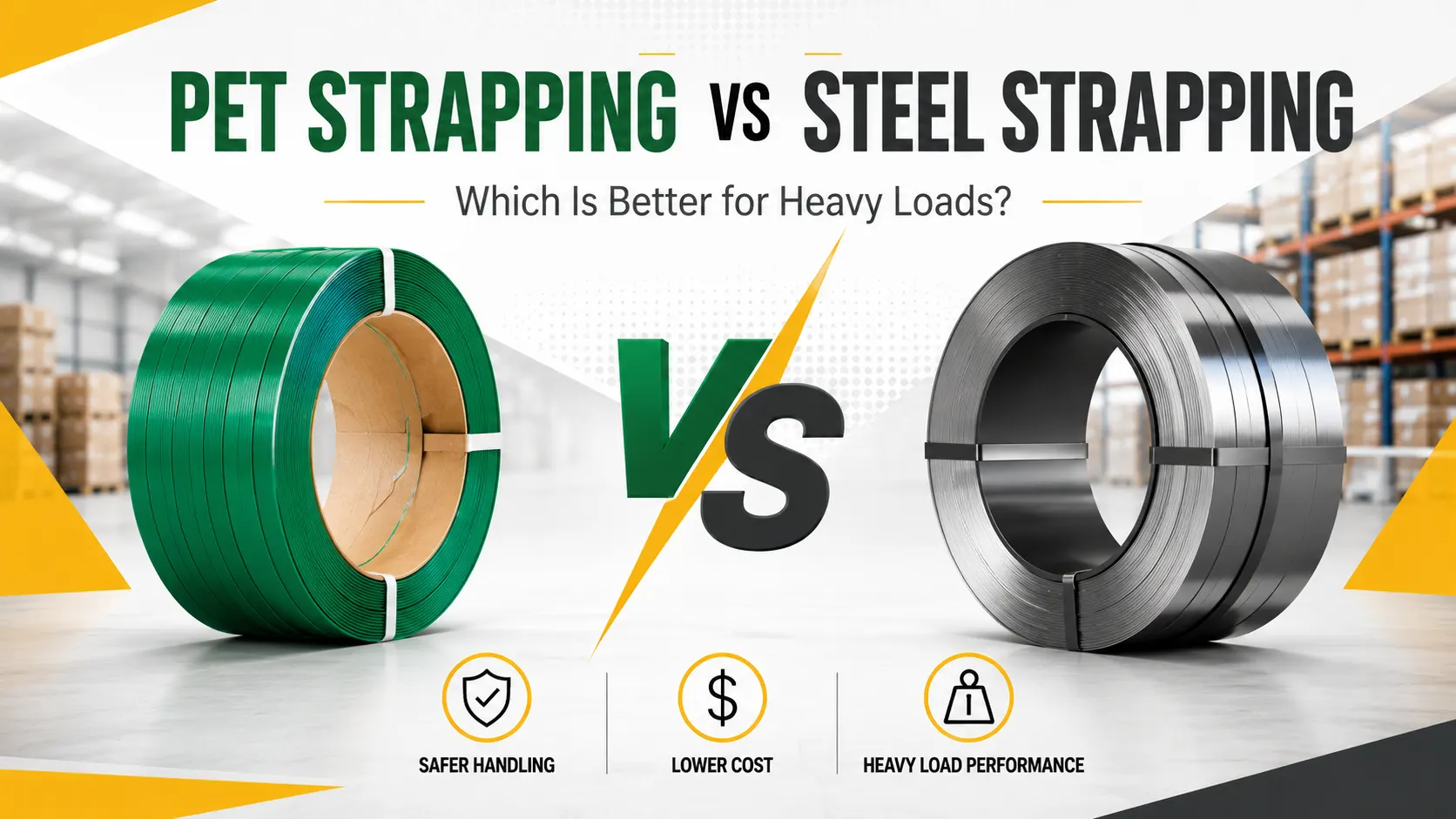
PET stands for polyethylene terephthalate. It is the same base material used in plastic drink bottles, but before you picture something flimsy, understand that industrial grade! PET strapping is a completely different product engineered for serious load securing.
The manufacturing process aligns the polymer chains to create a strap that is tough, flexible under sudden force, and capable of maintaining tension across a full freight journey. It is not soft packaging material. It is engineered strapping that has replaced steel in industries far heavier than most NZ operations deal with.
PET strapping comes in two forms that you will hear about regularly. Machine grade PET strapping is designed for automatic and semi automatic strapping machines and is used on production lines where speed and consistency matter. Hand grade PET strapping is the thicker, stiffer version used with manual tensioning tools, and it is what most smaller operations and spot securing jobs rely on.
What Is Steel Strapping?
Steel strapping is exactly what it sounds like. A flat band of carbon steel, tensioned tightly around a load and sealed with a metal clip or weld. It has been the go to for heavy industrial securing since before most of us were working in warehouses.
Its main advantage is rigidity. Steel does not stretch. When you tension it and seal it, it stays at that exact tension with virtually zero give. For certain load types, that is genuinely what you need.
Steel strapping shows up most in structural steel and metal coil securing, large timber export bundles, heavy masonry and brick packs, and oversized machinery transport. These are real applications where steel earns its place.
The problem is that steel gets used well outside those specific applications, often just because nobody questioned whether there was a better option.
PET Strapping vs Steel Strapping: Head to Head
| Feature | PET Strapping | Steel Strapping |
| Tensile strength | Very high, matches or exceeds steel for most NZ applications | Extremely high |
| Elastic recovery | 10 to 15%, strap stays tight as load compresses and settles | Near zero, what you apply is what stays |
| Load surface safety | No sharp edges, no scratching | Sharp edges frequently damage product surfaces |
| Worker safety | No snapback, no lacerations, lighter to handle | Snapback injuries are well documented, edges cut |
| Weight | Lightweight, easy to handle on the job | Heavy rolls, adds weight to outgoing freight |
| Corrosion resistance | Completely rust free, handles wet and outdoor conditions | Rusts in damp storage and outdoor exposure |
| Cost per metre | Lower than steel, consistently | Higher, particularly painful at volume |
| Recyclability | Recyclable through PET streams, made from recycled material | Recyclable as scrap metal |
| Tools | Ergonomic, battery powered and pneumatic options widely available | Heavy tools, more physical demand on operators |
| Best suited to | Pallets, timber, paper rolls, concrete, export freight | Metal coils, rigid non compressible loads with sharp edges |
Can PET Strapping Actually Handle Heavy Loads?
This is the question that comes up in almost every conversation we have with NZ businesses still running steel. The assumption is that plastic means light duty. It does not.
Here is what people miss about strapping physics. A load does not sit still during transit. It vibrates, it compresses slightly, it shifts on corners, it settles over the course of a freight journey. Steel strapping cannot adapt to any of that. It applies a fixed tension, and when the load moves or compresses beneath it, the steel strap either becomes loose or snaps under sudden shock loading. Neither outcome is good.
PET strapping works differently. It has what is called elastic recovery, meaning it stretches slightly under shock force and then pulls back to its original tension. So when your pallet hits a bump on the road between Auckland and Hamilton, the PET strap absorbs that force and then reapplies tension. The steel strap would have either snapped or gone slack.
For palletised goods, timber packs, concrete products, paper rolls, and export freight, this is not a marginal difference. It is the reason PET outperforms steel in real world conditions on the kinds of loads most NZ businesses are actually securing.
The one area where steel has a genuine technical advantage is loads with razor sharp cut edges, think raw steel coils or freshly cut structural steel sections where the edge of the load could physically cut through a PET strap under tension. That is a real scenario and steel is the right answer there. For almost everything else, PET does the job and does it better.
Safety: And This Is Where the Conversation Gets Serious
I want to spend a bit more time on this one because it matters and it does not get talked about enough.
Steel strapping injures people. Not occasionally, not in freak accidents. It injures workers regularly in warehouses and freight operations that use it every day. The edges are sharp from the moment you unroll it to the moment it ends up as an offcut on the floor. When a steel strap snaps or is cut under tension, it recoils with serious force. Lacerations from steel strapping are a well documented workplace injury across industrial sectors.
PET strapping has no sharp edges. When it is cut or breaks under load, it does not whip back with dangerous force. Workers can handle it without the same level of risk. It is also lighter, which matters across a full shift when your team is applying dozens or hundreds of straps a day.
Under New Zealand’s Health and Safety at Work Act, employers have a duty to eliminate or minimise risks to workers where practicable. Switching from steel to PET where the application allows it is a straightforward way to reduce injury risk in your operation. It is not a soft or optional consideration.
The Cost Picture Is Not What Most People Expect
The assumption is usually that steel is cheaper because it is the old standard. In practice, it is not, and the gap widens once you look beyond the price per roll.
PET strapping costs less per metre than steel of comparable strength. Add to that the fact that PET rolls are lighter, so you pay less in freight to get stock into your facility. PET tools are less expensive to buy and easier to maintain than steel strapping equipment. PET does not corrode, so stock stored in your warehouse does not deteriorate and get written off the way steel rolls do in humid or wet conditions.
Then there is the labour side. PET is faster to apply, particularly with machine grade systems. Your team gets through more strapping runs in a shift, and they arrive at the end of that shift in better shape because the tools are lighter and easier to operate.
For most NZ warehouses running any kind of meaningful volume, the switch to PET pays for itself quickly. We are not talking about years, in most cases it is months.
What About Sustainability? It Matters More Now Than It Did Five Years Ago
New Zealand businesses are under increasing pressure to demonstrate responsible procurement and reduce packaging waste. If your operation is working toward waste reduction targets, sustainability reporting, or simply trying to stay ahead of NZ’s evolving product stewardship regulations, strapping material is worth looking at.
PET strapping is manufactured from recycled polyester material and is itself recyclable through industrial PET channels. The closed loop story is genuinely solid. Steel strapping, while technically recyclable as scrap, requires substantially more energy to process, and in practice, corroded or contaminated steel strapping frequently ends up in landfill rather than being recovered.
It is not the biggest lever in your sustainability programme, but it is an easy one to pull.
When You Should Stick With Steel Strapping
I said at the start that I would be straight with you, so here it is. There are applications where steel is the right call and you should not switch just because this blog told you PET is generally better.
If you are securing raw steel coils, freshly cut structural steel sections, or any load where the material itself has edges sharp enough to cut through a PET strap under working tension, steel on steel is appropriate. This is a real technical limitation of PET and it is worth respecting.
If you are working with extremely rigid loads that will not compress or settle at all during transit, and where any elongation in the strap would create an unacceptable result, steel’s near zero elongation can be the right choice.
Outside of those two scenarios, the honest answer is that most NZ businesses using steel are doing so out of inertia, not because their application actually requires it.
A Word on CustomPack NZ
Custompack supply machine grade and hand grade PET strapping to businesses across New Zealand, from small operations doing a few pallets a day to large distribution facilities running automated strapping lines. Our range covers multiple widths and thicknesses, so whether you are securing light pallets or heavy export timber bundles, we can match the right specification to your load. If you are currently on steel and want an honest conversation about whether PET would work for your operation, get in touch at sales@custompack.co.nz and we will work through it with you.
Choosing the Right Strapping for Your Load: A Practical Guide
If you are securing palletised goods of any weight, the answer is PET. If you are bundling timber for domestic distribution or export, PET handles it well and the elastic recovery keeps bundles tight across long haul journeys. Paper and cardboard rolls, concrete products, pavers, bricks, and compressible loads of all kinds are natural fits for PET strapping.
If you are storing loads outdoors before dispatch, or if your freight is going into containers where condensation is a real issue, PET’s complete resistance to corrosion is a significant practical advantage over steel.
The situations where steel makes sense, specifically raw metal products with cut edges or rigid loads requiring absolute zero elongation, are real but they represent a small subset of what most NZ operations are actually securing.
So, Which One Is Actually Better?
For the vast majority of businesses in New Zealand, PET strapping is the better choice for heavy loads. It performs as well or better in real working conditions, it is safer for your team, it costs less to run, and it handles NZ’s freight environment across domestic trucking and export shipping without the corrosion risk that comes with steel.
Steel strapping is not obsolete. It has a genuine role in specific heavy industrial applications involving sharp edged metal products or extremely rigid non compressible loads. If that is your situation, steel belongs in your operation.
But if you are using steel because it is always been the way, take an hour to properly compare it against PET for your specific loads. Talk to a supplier who will give you a straight answer rather than just sell you whatever you are already buying. The numbers and the safety case for PET are hard to argue with once you lay them out properly.
Most businesses that make the switch wonder why they waited as long as they did.
FAQs:
1. Is PET strapping as strong as steel strapping for heavy loads?
For the loads most NZ businesses are securing, yes. PET strapping delivers very high tensile strength combined with elastic recovery that actually makes it more effective than steel on pallets, timber, concrete, and compressible freight. The only application where steel has a strength advantage that matters in practice is securing loads with extremely sharp cut edges that would physically damage the PET strap itself.
2. What does PET strapping stand for?
PET is short for polyethylene terephthalate, the same polymer used in plastic drink bottles. Industrial grade PET strapping is a heavily engineered version of that material, processed specifically to deliver the tensile strength and elongation recovery properties needed for load securing.
3. Is PET strapping safe to work with?
Significantly safer than steel. There are no sharp edges on PET strapping, it does not produce dangerous snapback when cut under tension, and the tools used to apply it are lighter and less physically demanding than steel strapping equipment. For businesses taking their obligations under the Health and Safety at Work Act seriously, this is a meaningful difference.
4. Can I use PET strapping on heavy pallets?
Yes, and it is the preferred choice for heavy palletised loads across manufacturing, logistics, and export freight. The key is selecting the right width and thickness for your load weight. Your supplier should be able to guide you on this based on your specific application.
5. What is the difference between machine grade and hand grade PET strapping?
Machine grade PET strapping is produced for use in automatic and semi automatic strapping machines. It is typically thinner and consistent in dimension for reliable machine feed. Hand grade PET strapping is thicker and stiffer, designed for manual tensioners and sealers. Both deliver excellent load security in their respective applications.
6. Is PET strapping recyclable in New Zealand?
Yes. PET strapping is produced from recycled polyester material and can be recycled again at end of use through industrial PET recycling channels. It is a more sustainable option than steel in most NZ packaging operations.
7. Why are so many NZ businesses switching from steel strapping to PET?
Cost is usually the starting point. PET is cheaper per metre, the tools cost less, and the stock does not corrode in storage. Safety is often what accelerates the decision, because the injury risk profile of PET versus steel is dramatically different. Once businesses run the numbers and look at their incident records, the case for staying on steel becomes very thin for most applications.
8. How do I know which width of PET strapping I need?
Width selection is driven by your load weight and the tension required to hold it securely. As a general starting point, 12mm PET suits light to medium pallets, 16mm handles heavier loads, and 19mm or wider is used for the heaviest freight including large timber bundles and heavy export pallets. A good supplier will spec this properly for you based on your actual load weights and transport conditions.
9. Does PET strapping rust?
No. PET strapping is completely corrosion resistant. This is one of its most practical advantages in New Zealand’s climate, where outdoor storage, container shipping, and high humidity environments can cause steel strapping to corrode and lose integrity.
10. What tools do I need to apply PET strapping?
PET strapping requires a tensioner and sealer designed for polyester strapping. These are available in manual, pneumatic, and battery powered configurations. Battery powered tools have become the most popular choice in NZ warehouses over the past few years because they are fast, consistent, and significantly easier on operators across a full shift.